Bags and accessories are sold on Kaspi.kz without a separate permission: the «Аксессуары» (Accessories) section isn't one of the restricted categories. The main feature of this niche is two commission rates inside one section. Bags, backpacks, wallets, belts, headwear and umbrellas pay 15.5% including VAT, while suitcases, travel bags, wristwatches and sunglasses pay 12.5%. As for documents, most bags and belts are declared under TR CU 017/2011 using schemes 1d or 2d, and the applicant can be the seller. Below is what this means for your price and your product card.
In short
- Bags, belts and wallets don't need Kaspi's permission. Just check the brand: restricted brands have their own documents.
- Bags, backpacks, wallets, belts, hats, umbrellas: 13.5% without VAT and 15.5% with VAT.
- Suitcases, travel bags, wristwatches, sunglasses: 10.9% without VAT and 12.5% with VAT.
- Under TR CU 017/2011, bags, backpacks, gloves and belts are declared under schemes 1d or 2d for up to 3 years. Headwear goes under 3d, 4d or 6d with testing in an accredited laboratory.
- On an 18,000 ₸ bag, the difference between the two rates is 540 ₸ on every sale.
What's in the «Аксессуары» section and which commission applies where
In the 2026 Kaspi.kz Store tariffs, the «Аксессуары» section is split into subcategories, and their rates differ (2026 tariffs, PDF). It's handy to keep this table nearby when you calculate a purchase.
| Kaspi subcategory | Without VAT | With VAT |
|---|---|---|
| Bags, backpacks, wallets and card holders, document covers | 13.5% | 15.5% |
| Belts, suspenders, ties, clothing accessories | 13.5% | 15.5% |
| Headwear, scarves and shawls, gloves and mittens | 13.5% | 15.5% |
| Umbrellas, keychains and key holders | 13.5% | 15.5% |
| Suitcases, suitcase covers, travel bags, travel accessories | 10.9% | 12.5% |
| Wristwatches and pocket watches | 10.9% | 12.5% |
| Sunglasses, eyewear cases and accessories | 10.9% | 12.5% |
You can see that a "bag" and a "travel bag" are two subcategories with different rates. It's tempting to put a city bag under travel bags and save. Don't. The characteristics and category must match the product, otherwise Kaspi may link it to a different card (q3554, updated Feb 23, 2026), and a buyer who was looking for a travel bag gets something else and returns it. If it really is a travel model with a carry-on size, choose travel bags honestly.
Brand restrictions come up here more often than in decor: well-known bag and accessory brands are counterfeited a lot. For a restricted brand you need a letter or contract from the rights holder, invoices and payment for the last 90 days, from 10 units (q2618, updated Jul 10, 2026). Counterfeits and replicas are banned in any case (q3904, updated Jan 16, 2026). More in brand restrictions on Kaspi.
Documents under TR CU 017/2011
Bags, belts and wallets fall under TR CU 017/2011 "On the safety of light industry products". Its Article 1 directly names leather goods and textile haberdashery (TR CU 017/2011).
Who can be the applicant
Under Article 11, the applicant can be the manufacturer, a person authorised by it, or the seller (supplier). For a Kaspi seller this matters: if you bring bags from China in a batch, you can register the declaration in your own name without waiting for the factory to do it.
Which scheme you need
The regulation splits products into three groups. Everything that isn't subject to certification and isn't in group 3d is declared under schemes 1d or 2d. That includes bags, suitcases, briefcases, backpacks, cases, folders, gloves and belts. The declaration is valid for up to 3 years, and tests can be done in any laboratory.
| Product | Form | Scheme | Validity |
|---|---|---|---|
| Bags, backpacks, suitcases, briefcases | Declaration | 1d or 2d | Up to 3 years |
| Belts, gloves, cases, folders | Declaration | 1d or 2d | Up to 3 years |
| Headwear | Declaration | 3d, 4d or 6d, accredited lab | Up to 5 years |
Hats are a separate story here: under the regulation they're in the group with testing in an accredited laboratory. If you sell both bags and hats, the documents for them will differ. School bags may also fall under TR CU 007/2011 if the manufacturer declares them as children's products; more in children's goods on Kaspi.
Marking on the product
Article 9 requires leather goods to state the face material, the model and care or use recommendations. If the bag's label only has the factory logo, that's a question for the supplier before you pay for the batch, not after.
The product card: what people ask about a bag
A bag buyer almost never sees it in person, so they decide by the numbers. The minimum without which a card loses orders:
- dimensions in centimetres: height, width, depth;
- face and lining material as written on the label: "genuine leather", "faux leather", "textile";
- the number of compartments and pockets, the closure type;
- handle length and whether there's a detachable shoulder strap;
- for a backpack: whether a laptop fits, and what screen size;
- for a belt: length and width, buckle type.
The regulation has an appendix with the breaking load for handles: at least 50 N for women's and everyday bags, 90 N for shopping and beach bags, 70 N for school bags, 170 N for travel bags and 400 N for hard suitcases. You don't need to put these numbers in the card, but they explain why handles break on a cheap "travel" bag and why such bags come back.
Different colours of one model are different SKUs, and they can be combined only under Kaspi's rules (q5146, updated Jul 23, 2026). A bag that's brown leather in the photo and arrives ginger is as good as returned. Shoot each colour separately, in daylight. More on photos in product photos for Kaspi.
Returns and delivery
A buyer can return an unused bag, belt or wallet within 14 days, or within 30 days if there's a defect (q2269, updated Sep 21, 2026). Kaspi refunds the commission on a returned order (q1344, updated Jan 6, 2026), but not the delivery charged at the «Выдан» ("Handed over") status (q2288, updated Jun 16, 2026).
Kaspi Delivery tariffs common in this niche, with VAT:
| Order | Within the city | Across Kazakhstan |
|---|---|---|
| 5,000–10,000 ₸ (belt, wallet, hat) | 811 ₸ | 927 ₸ |
| from 10,000 ₸, up to 5 kg (bag, backpack) | 1,275 ₸ | 1,507 ₸ |
| from 10,000 ₸, 5–15 kg (suitcase) | 1,565 ₸ | 1,971 ₸ |
Ship a leather bag with filler inside so it keeps its shape, and in a box rather than a plastic bag. If the packaging doesn't meet Kaspi's requirements, compensation for damage may be refused (q2296, updated Nov 5, 2025). More in returns on Kaspi for sellers.
The math: what's left from a bag, a suitcase and a belt
A hypothetical example, not a client case. Prices and purchase costs are for illustration; taxes and packaging are not included. Delivery is across Kazakhstan, with VAT.
| Item | Bag | Suitcase | Belt |
|---|---|---|---|
| Price | 18,000 ₸ | 32,000 ₸ | 8,000 ₸ |
| Rate | 15.5% | 12.5% | 15.5% |
| Commission | 2,790 ₸ | 4,000 ₸ | 1,240 ₸ |
| Purchase price | 9,500 ₸ | 19,000 ₸ | 3,200 ₸ |
| Delivery | 1,507 ₸ | 1,971 ₸ | 927 ₸ |
| Left over | 4,203 ₸ | 7,029 ₸ | 2,633 ₸ |
If the bag were in a 12.5% subcategory, the commission would be 2,250 ₸ and 4,743 ₸ would be left. That 540 ₸ difference isn't a reason to switch categories; it's a reason to build the right rate into the price from the start.
Minimum price = (Purchase price + Delivery + Packaging) ÷ (1 − Commission with VAT)
For the bag: (9,500 + 1,507) ÷ 0.845 ≈ 13,026 ₸. For the suitcase: (19,000 + 1,971) ÷ 0.875 ≈ 23,967 ₸. For the belt: (3,200 + 927) ÷ 0.845 ≈ 4,884 ₸.
Watch the divisor. At 15.5% it's 0.845, not 0.875, and if you take the clothing rate out of habit, the belt's minimum price comes out 167 ₸ too low. The 10,000 ₸ threshold matters too. An 8,000 ₸ belt is delivered for 927 ₸, but a 12,000 ₸ "belt plus wallet" set already goes at the 1,507 ₸ tariff. A set pays off only if the amount added to the price is more than that 580 ₸ difference. How not to sell at a loss is covered in how not to sell at a loss on Kaspi.
Small accessories under 5,000 ₸
Keychains, document covers, simple wallets: these are receipts of one or two thousand tenge. Delivery here is cheap, but the profit per unit is also small, so every mistake shows. The same hypothetical approach:
| Item | Keychain | Wallet |
|---|---|---|
| Price | 2,500 ₸ | 4,500 ₸ |
| Commission 15.5% | 388 ₸ | 698 ₸ |
| Purchase price | 900 ₸ | 2,000 ₸ |
| Delivery with VAT | 173 ₸ | 231 ₸ |
| Left over | 1,039 ₸ | 1,571 ₸ |
The keychain's minimum price is (900 + 173) ÷ 0.845 ≈ 1,270 ₸, the wallet's is (2,000 + 231) ÷ 0.845 ≈ 2,641 ₸. One wallet return eats 231 ₸ of delivery that won't come back, plus the time to receive and repack it. If a model gets returned often, fix the photo and description rather than cutting the price.
For small goods, care with the card matters especially. A keychain or cover is bought in a minute from the photo, and people compare price and delivery time, not quality. If you and your neighbour have the same cover, the winner isn't the one with the longer description but the one ranked first in the card who delivers faster.
Common mistakes when selling bags and accessories
- Calculating belts and bags at the clothing rate. Clothing is 12.5%, bags and belts are 15.5%. The minimum price comes out too low.
- Putting a city bag under travel bags for the rate. The category must match the product, otherwise the card is wrong and returns grow.
- No dimensions in centimetres. The buyer can't tell if a laptop or A4 documents fit and goes to a neighbour.
- One photo for all colours. Leather colour on screen and in person don't match, and the bag comes back.
- No declaration, although the seller can be the applicant. Under TR CU 017/2011 the seller has the right to register it in their own name.
- Hats under the same scheme as bags. Headwear has its own group and testing in an accredited laboratory.
- Replicas of well-known brands. Kaspi's rules ban counterfeits without exception.
Checklist: bags and accessories on Kaspi
First, use the tariff table to check which subcategory each item falls into, and calculate the minimum price at the right rate. Without that, none of the other items will save your margin.
- [ ] Brands are checked against the restricted list; documents are collected for restricted ones.
- [ ] Bags, backpacks and belts have a TR CU 017/2011 declaration, and the models match.
- [ ] Headwear has a separate declaration under scheme 3d, 4d or 6d.
- [ ] The label shows the face material, model and use recommendations.
- [ ] The card lists dimensions, material, compartments, closure and handle length.
- [ ] Each colour is shot separately in daylight.
- [ ] The minimum price for bags and belts is calculated with the 0.845 divisor.
- [ ] The 10,000 ₸ threshold is accounted for on cheap accessories and sets.
- [ ] Leather bags are shipped in a box with filler.
How to automate prices for bags and accessories
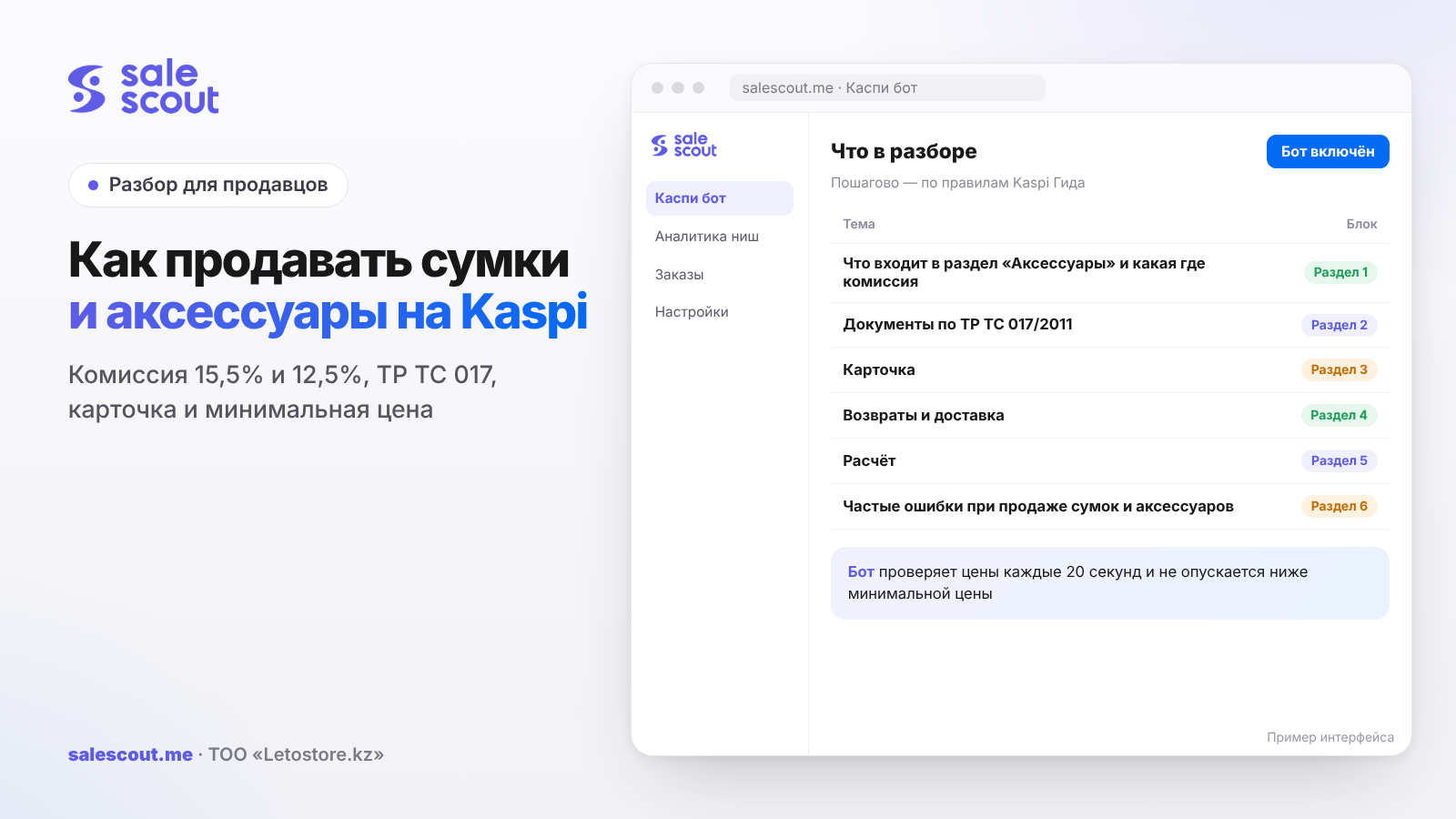
A popular backpack model's card can have dozens of sellers, and the price changes throughout the day. The SaleScout Kaspi bot checks prices every 20 seconds, keeps you at the top of the product card and never goes below the minimum price you set. When a competitor raises their price or leaves the card, the bot raises yours too. SaleScout niche analytics shows which bag and accessory models people search for and how many sellers are in the card. You can try the bot free for 7 days, no card required.
Frequently asked questions about selling bags and accessories on Kaspi
Do you need permission to sell bags on Kaspi?
No, «Аксессуары» isn't on the list of restricted categories. If your brand is on the restricted list, you'll be asked for documents: a letter or contract from the rights holder, invoices and payment for 90 days.
What is Kaspi's commission on bags?
Regular bags, backpacks and wallets are 15.5% for VAT payers and 13.5% without VAT. Suitcases and travel bags are cheaper: 12.5% and 10.9%.
Why is the commission on a belt higher than on clothing?
In Kaspi's tariffs a belt belongs to accessories, not clothing, with a rate of 15.5% including VAT. Clothing pays 12.5%, so a belt and a jacket in the same store must be calculated differently.
What document do bags need under TR CU 017/2011?
A declaration of conformity under scheme 1d or 2d for up to 3 years. Tests can be done in any laboratory, and the applicant can be the seller, not just the factory.
Do hats need a declaration?
Yes, but under a different scheme than bags. In TR CU 017/2011, headwear is in the 3d, 4d or 6d group, with testing in an accredited laboratory and validity of up to 5 years.
Can a bag bought on Kaspi be returned?
If it hasn't been used, the buyer can return it within 14 days. With a defect, within 30 days. Kaspi refunds the commission on a returned order to the seller, but not the delivery.
How do you calculate the minimum price for a bag?
Add up the purchase price, delivery with VAT and packaging, and divide by 0.845 if the rate is 15.5%. A bag bought for 9,500 ₸ and delivered to another city comes out at about 13,026 ₸.
Sources
- «Тарифы Магазина на Kaspi.kz 2026» (Kaspi.kz Store tariffs 2026, PDF), section «Аксессуары» — https://guide.kaspi.kz/cdn/content/pay/product/documents/Magazin/Tarify_Magazina_na_Kaspi_kz_2026.pdf (checked Oct 30, 2026)
- Kaspi Guide. «Разрешение на продажу ограниченных категорий» (Permission to sell restricted categories) — https://guide.kaspi.kz/partner/ru/shop/goods/limit/q2224 (updated Oct 5, 2026)
- Kaspi Guide. «Разрешение на продажу ограниченных брендов» (Permission to sell restricted brands) — https://guide.kaspi.kz/partner/ru/shop/goods/limit/q2618 (updated Jul 10, 2026)
- Kaspi Guide. «Какие товары нельзя продавать в Магазине на Kaspi.kz» (Products that can't be sold in the Kaspi.kz Store) — https://guide.kaspi.kz/partner/ru/shop/conditions/q3904 (updated Jan 16, 2026)
- EEC. TR CU 017/2011 «О безопасности продукции лёгкой промышленности» (On the safety of light industry products), regulation page — https://eec.eaeunion.org/comission/department/deptexreg/tr/bezopProductLegkProm.php; text (Articles 1, 9, 11 and appendices) — https://eec.eaeunion.org/upload/medialibrary/e4f/TR-TS-ProduktLegProm.pdf
- Kaspi Guide. «Основные характеристики товара» (Main product characteristics) — https://guide.kaspi.kz/partner/ru/shop/goods/card/q3554 (updated Feb 23, 2026); «Объединение товаров в одной карточке» (Combining products in one card) — https://guide.kaspi.kz/partner/ru/shop/goods/card/q5146 (updated Jul 23, 2026)
- Kaspi Guide. «Сроки возврата товара» (Product return periods) — https://guide.kaspi.kz/partner/ru/shop/refund/q2269 (updated Sep 21, 2026)
- Kaspi Guide. «Комиссия Магазина на Kaspi.kz» (Kaspi.kz Store commission) — https://guide.kaspi.kz/partner/ru/shop/conditions/q1344 (updated Jan 6, 2026)
- Kaspi Guide. «Тарифы Kaspi Доставки» (Kaspi Delivery tariffs) — https://guide.kaspi.kz/partner/ru/shop/delivery/shipping/q2288 (updated Jun 16, 2026); «Как подготовить товар для передачи на Kaspi Доставку» (How to prepare goods for Kaspi Delivery) — https://guide.kaspi.kz/partner/ru/shop/delivery/shipping/q2296 (updated Nov 5, 2025)
The sources are in Russian; original titles are given with English translations. All links checked Oct 30, 2026.
Bota, analyst
SaleScout is our company's product. Kaspi and Kaspi.kz are trademarks of Kaspi.kz JSC; SaleScout is not affiliated with Kaspi.