You can sell stationery on Kaspi.kz without permission: the «Канцелярские товары» (Stationery) section isn't a restricted category, and its commission is 12.5% including VAT. Documents depend on who the product is for. Pens, notebooks, pencil cases and school diaries that the manufacturer declares as products for children and teenagers fall under TR CU 007/2011 and need a declaration. The hardest part of this niche is the economics: receipts are small, and a single 350 ₸ pen leaves about 130 ₸ after commission and delivery. Below is how to deal with that.
In short
- Stationery doesn't need Kaspi's permission; the commission is 10.9% without VAT and 12.5% with VAT for the whole section.
- School writing supplies for children and teenagers are declared under TR CU 007/2011 using schemes 1d or 2d.
- For notebooks, the regulation sets a paper density of at least 60 g/m² and bans glossy paper.
- Delivering an order under 1,000 ₸ costs 57 ₸ with VAT; from 10,000 ₸ it's already from 1,275 ₸. A 9,900 ₸ set can leave more money than a 10,100 ₸ one.
- A box of office paper is heavy: when it goes to another city, the profit on it almost disappears.
What you need to list stationery
The «Канцелярские товары» section on Kaspi is big: writing and school supplies, paper and notebooks, small office items, stamps and seals, display boards, calculators, binding equipment. Almost everything here goes at one rate: 10.9% without VAT and 12.5% with VAT (2026 tariffs, PDF).
Stationery isn't on the list of restricted categories (q2224, updated Oct 5, 2026). You'll need permission only if the brand is on the restricted list; then you need a letter or contract from the rights holder and invoices with payment for the last 90 days, from 10 units (q2618, updated Jul 10, 2026).
There's a lower boundary too. A product's price on Kaspi must be between 10 ₸ and 5 million ₸ (q1345, updated May 29, 2024). That rarely gets in the way, but if you wanted to sell paper clips one by one for 5 ₸, you'll have to pack them together.
Documents: when stationery becomes a children's product
TR CU 007/2011 "On the safety of products intended for children and teenagers" covers school writing supplies. The regulation's text describes them as "stationery (pens, markers, rulers, pencils, erasers, notebooks, school diaries, brushes…) declared by the manufacturer as intended for children and teenagers" (TR CU 007/2011).
The key words are "declared by the manufacturer". An office pen in a box of 50 and a pen in a "First Grader" set with cartoon characters are different products from the regulation's point of view. The manufacturer doesn't address the first one to children. The second is a children's product, and it needs a declaration.
Which scheme and how long it's valid
Under Article 12, school writing supplies are declared under schemes 1d or 2d based on the applicant's own evidence. The declaration is valid for no more than 3 years. It's the simplest route the regulation offers, but that doesn't mean you can skip the document.
What the regulation requires of the product itself
Article 8 sets requirements worth knowing when you choose a supplier, not afterwards:
| Product | TR CU 007/2011 requirement |
|---|---|
| All school writing supplies | Chemical safety under Appendix 22 |
| Notebooks | Paper density at least 60 ± 3 g/m², no gloss |
| Notebook ruling | Line thickness 0.1–0.4 mm |
| Drawing albums | Paper 100–160 g/m² |
| Technical drawing paper | 160–200 g/m² |
If a supplier brings notebooks on thin glossy paper, you won't be able to declare them as school notebooks. Article 9 covers marking separately. On children's products in general, see children's goods on Kaspi.
Calculators and other electronics in the same section follow their own rules. The regulations on low-voltage equipment start at 50 V AC, and a battery calculator doesn't fall under them. But plug-in laminators and shredders are a different case; check their documents with the supplier.
The product card: what buyers compare in stationery
Stationery buyers compare quantity and format, not the brand. "12 colour pencils" and "24 colour pencils" from the same series are different products and can't be combined in one card: Kaspi treats different SKUs as different products (q5146, updated Jul 23, 2026). Kaspi uses the main characteristics to find the right card for a product (q3554, updated Feb 23, 2026), so fill them in precisely.
What usually decides the choice:
- for pens: the number per pack, ink colour, line width, type: ballpoint, gel, oil-based;
- for notebooks: the number of sheets, ruling (squares or lines), format, paper density;
- for paper: format, density, sheets per ream and reams per box;
- for pencil cases and folders: dimensions and material;
- for first-grader sets: the full contents as a list, not the phrase "everything for school".
The set's contents matter most. If the description says one thing and the box holds another, the buyer returns the whole set, and the delivery charged to you doesn't come back, even though it was one ruler that upset them. A photo of the set laid out, with every item visible, helps avoid such questions. How to build a card from scratch is covered in how to create a product card on Kaspi.
The economics of a small receipt
With stationery, the main trap is delivery. Kaspi Delivery tariffs depend on the order amount (q2288, updated Jun 16, 2026). They're charged when the order gets the «Выдан» ("Handed over") status, with VAT on top:
| Order amount | Without VAT | With VAT |
|---|---|---|
| under 1,000 ₸ | 49 ₸ | 57 ₸ |
| 1,000–3,000 ₸ | 149 ₸ | 173 ₸ |
| 3,000–5,000 ₸ | 199 ₸ | 231 ₸ |
| 5,000–10,000 ₸ | 699 / 799 ₸ | 811 / 927 ₸ |
| from 10,000 ₸, up to 5 kg | 1,099 / 1,299 ₸ | 1,275 / 1,507 ₸ |
For orders from 5,000 ₸, the first number is within the city, the second is across Kazakhstan. Below 5,000 ₸ there's no difference.
Let's count three items. This is a hypothetical example, not a client case: we made up the prices and purchase costs for illustration and left out taxes and packaging.
| Item | Pen | Pen set | Notebook set |
|---|---|---|---|
| Price | 350 ₸ | 2,400 ₸ | 3,200 ₸ |
| Commission 12.5% | 44 ₸ | 300 ₸ | 400 ₸ |
| Purchase price | 120 ₸ | 1,100 ₸ | 1,700 ₸ |
| Delivery with VAT | 57 ₸ | 173 ₸ | 231 ₸ |
| Left over | 129 ₸ | 827 ₸ | 869 ₸ |
Minimum price = (Purchase price + Delivery + Packaging) ÷ (1 − Commission with VAT)
For the pen: (120 + 57) ÷ 0.875 ≈ 202 ₸. The numbers are small, but the proportion is the same as for expensive goods. And the packaging we left out can eat a noticeable share of that 129 ₸ on a pen. That's why it pays to turn a single pen into a set or a pack, so one delivery and one packing job cover more goods.
The 10,000 ₸ threshold
Between 9,999 ₸ and 10,000 ₸, delivery to another city jumps from 927 ₸ to 1,507 ₸. On school sets this is noticeable.
| Item | Set at 9,900 ₸ | Set at 10,100 ₸ |
|---|---|---|
| Commission 12.5% | 1,238 ₸ | 1,263 ₸ |
| Purchase price | 5,600 ₸ | 5,600 ₸ |
| Delivery across Kazakhstan | 927 ₸ | 1,507 ₸ |
| Left over | 2,135 ₸ | 1,730 ₸ |
The set that's 200 ₸ more expensive leaves 405 ₸ less. If you want to cross the threshold, the price increase must be bigger than the delivery difference, which means the set has to become noticeably fuller. More on how the formulas work on different receipts in how not to sell at a loss on Kaspi.
Paper: a heavy product with a small markup
A4 office paper is usually bought by the box, and ream by ream a box gains weight fast. If it's heavier than 5 kg but lighter than 15, and the order is from 10,000 ₸, Kaspi charges 1,565 ₸ within the city and 1,971 ₸ across Kazakhstan, with VAT.
Take a 12.5 kg box that we sell for 14,400 ₸ and bought for 10,500 ₸ (hypothetical numbers too). Kaspi takes 1,800 ₸ in commission. If the buyer is in your city, you keep 535 ₸. If they're in another city, 129 ₸, less than from a single pen. The intercity minimum price comes out at (10,500 + 1,971) ÷ 0.875 ≈ 14,253 ₸, only about a hundred and fifty tenge below the selling price.
So at this markup, paper sent to other cities on Kaspi brings in almost no money. The options: sell it only with delivery within your own city, from the warehouse where you keep it, or keep it as a product that draws buyers into your store and earn on the rest. State the weight in the card precisely: the tariff is calculated by it. It's worth wrapping a box of paper in film or tape: corners get crushed during loading, and if the packaging doesn't meet Kaspi's requirements, compensation for damage may be refused (q2296, updated Nov 5, 2025). A buyer who receives paper with crumpled edges has the right to return it as defective, and crumpled sheets really are useless in a printer. On packing heavy boxes, see packaging for Kaspi Delivery.
Season: school and year-end
School stationery depends on the school year; office stationery depends on how companies buy. It's better to look at your peaks in your own sales from past years than to go by feel. How to plan stock for a seasonal peak is covered in seasonality of sales on Kaspi.
Return rules here are the same as in other categories: a buyer can return an unused product within 14 days, or within 30 days if it's defective (q2269, updated Sep 21, 2026). Kaspi refunds the commission on a returned order (q1344, updated Jan 6, 2026), but not the delivery. On a 350 ₸ pen that's 57 ₸; on a set, 927 ₸.
Common mistakes when selling stationery on Kaspi
- Selling pens one at a time. The profit per unit is less than the packaging and the time to pack the order.
- Ignoring the 10,000 ₸ threshold. A set that's 200 ₸ more expensive can leave 400 ₸ less.
- No declaration for children's sets. If the manufacturer addresses the product to children, TR CU 007/2011 applies.
- Thin glossy notebooks sold as "school" notebooks. The regulation doesn't allow it: you need a density from 60 g/m² and no gloss.
- Paper to another city at the same price. On a 12.5 kg box, intercity delivery takes almost all the profit.
- Inaccurate weight in the card. The tariff is based on weight; understating it won't save your margin.
- One pricing approach for the whole range. Cheap items have their own logic, sets and paper have theirs.
Checklist: stationery on Kaspi
Before listing your range, split it into three groups: small items under 3,000 ₸, sets below and above the 10,000 ₸ threshold, and heavy paper. For each group, the minimum price is calculated with its own delivery tariff.
- [ ] Brands are checked against the restricted list.
- [ ] Products for children and teenagers have a TR CU 007/2011 declaration.
- [ ] Notebook paper density is from 60 g/m², with no gloss.
- [ ] Single small items are bundled into packs or sets.
- [ ] Sets around 10,000 ₸ are calculated with both delivery tariffs.
- [ ] Paper and heavy boxes have their exact weight stated.
- [ ] The minimum price for goods sent to other cities is calculated at the intercity tariff.
- [ ] Stock for the school season is planned in advance.
How to automate stationery prices
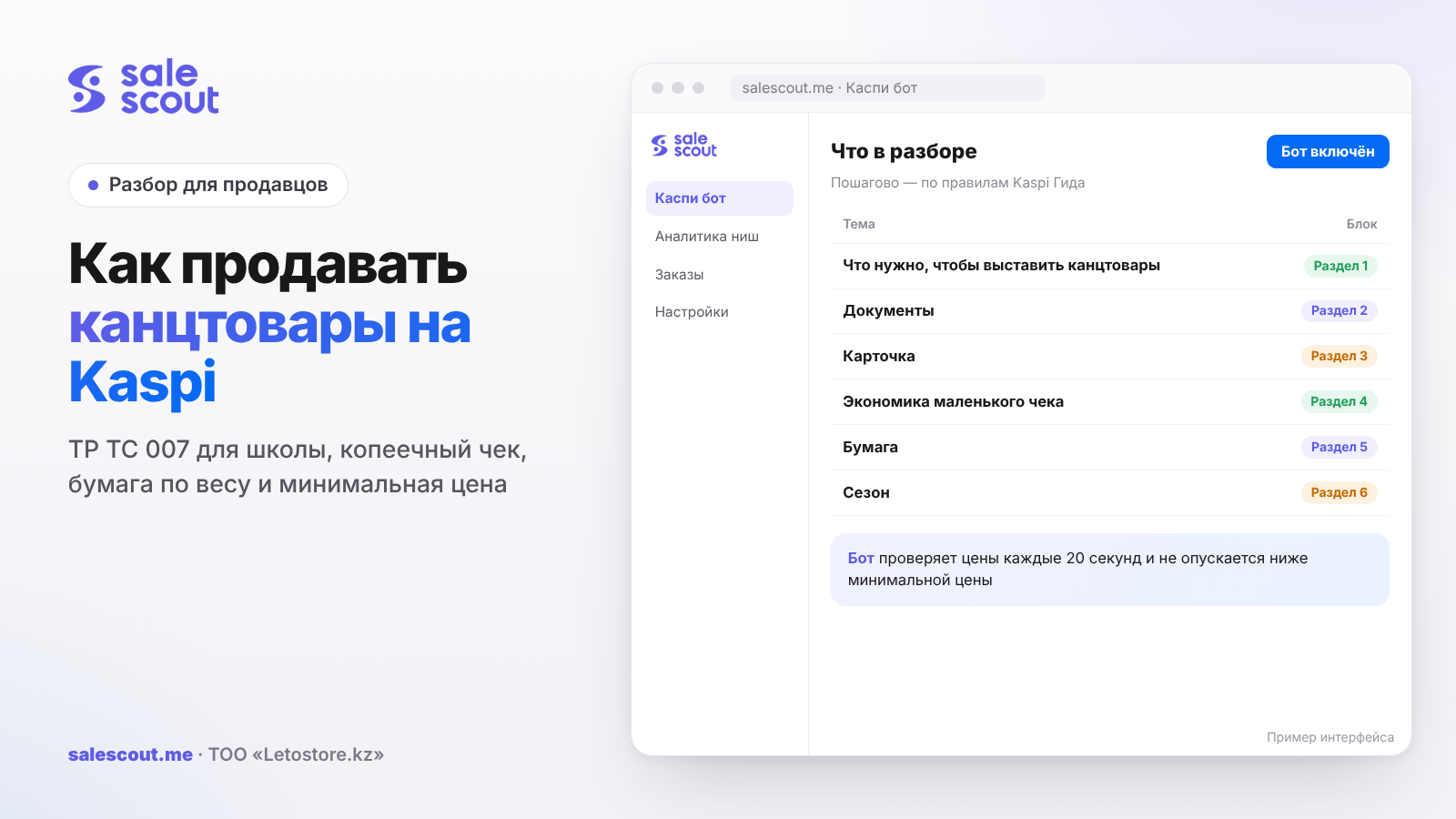
Stationery means hundreds of items with small receipts, and you can't watch each one by hand. The SaleScout Kaspi bot checks prices every 20 seconds, keeps you at the top of the product card and never goes below the minimum price you set for each product. When a competitor raises their price or runs out of stock, the bot raises yours too. SaleScout niche analytics helps you see which sets and items people search for and where there are few sellers. You can try the bot free for 7 days, no card required.
Frequently asked questions about selling stationery on Kaspi
Do you need permission to sell stationery on Kaspi?
No, stationery isn't a restricted category. Permission is needed only for a restricted brand: a letter or contract from the rights holder and invoices with payment for 90 days.
What is Kaspi's commission on stationery?
One rate for the whole section: 12.5% for VAT payers and 10.9% without VAT. Pens, notebooks, paper and calculators are all calculated the same way.
Do school notebooks and pens need a declaration?
Yes, if the manufacturer declares them as products for children and teenagers. Then TR CU 007/2011 applies, scheme 1d or 2d, valid for up to 3 years. Ordinary office stationery doesn't fall under this regulation.
What paper is suitable for school notebooks under TR CU 007/2011?
No thinner than 60 ± 3 g/m² and no gloss. Notebook lines are 0.1 to 0.4 mm. For drawing albums, 100–160 g/m²; for technical drawing, 160–200 g/m².
How much does it cost to deliver stationery through Kaspi?
It depends on the amount. An order under 1,000 ₸ is 57 ₸ with VAT, 1,000 to 3,000 ₸ is 173 ₸, 3,000 to 5,000 ₸ is 231 ₸. Above 10,000 ₸, a light parcel already costs 1,275 ₸ within the city and 1,507 ₸ to another city.
Is it worth selling office paper on Kaspi?
Within your own city, yes, if the markup is normal. To other cities, a box heavier than 5 kg is delivered for 1,971 ₸, and with a modest markup almost no profit is left.
What minimum price should you set for a pen?
Add up the purchase price, delivery with VAT and packaging, and divide by 0.875. For a pen bought for 120 ₸, without packaging, that comes to about 202 ₸.
Sources
- «Тарифы Магазина на Kaspi.kz 2026» (Kaspi.kz Store tariffs 2026, PDF), section «Канцелярские товары» — https://guide.kaspi.kz/cdn/content/pay/product/documents/Magazin/Tarify_Magazina_na_Kaspi_kz_2026.pdf (checked Oct 30, 2026)
- Kaspi Guide. «Разрешение на продажу ограниченных категорий» (Permission to sell restricted categories) — https://guide.kaspi.kz/partner/ru/shop/goods/limit/q2224 (updated Oct 5, 2026)
- Kaspi Guide. «Разрешение на продажу ограниченных брендов» (Permission to sell restricted brands) — https://guide.kaspi.kz/partner/ru/shop/goods/limit/q2618 (updated Jul 10, 2026)
- Kaspi Guide. «Минимальная и максимальная цена товара» (Minimum and maximum product price) — https://guide.kaspi.kz/partner/ru/shop/conditions/q1345 (updated May 29, 2024)
- EEC. TR CU 007/2011 «О безопасности продукции, предназначенной для детей и подростков» (On the safety of products intended for children and teenagers), regulation page — https://eec.eaeunion.org/comission/department/deptexreg/tr/bezopDeti.php; text (Articles 8, 9, 12) — https://eec.eaeunion.org/upload/medialibrary/0f8/P_797_1.pdf
- Kaspi Guide. «Тарифы Kaspi Доставки» (Kaspi Delivery tariffs) — https://guide.kaspi.kz/partner/ru/shop/delivery/shipping/q2288 (updated Jun 16, 2026); «Как подготовить товар для передачи на Kaspi Доставку» (How to prepare goods for Kaspi Delivery) — https://guide.kaspi.kz/partner/ru/shop/delivery/shipping/q2296 (updated Nov 5, 2025)
- Kaspi Guide. «Основные характеристики товара» (Main product characteristics) — https://guide.kaspi.kz/partner/ru/shop/goods/card/q3554 (updated Feb 23, 2026); «Объединение товаров в одной карточке» (Combining products in one card) — https://guide.kaspi.kz/partner/ru/shop/goods/card/q5146 (updated Jul 23, 2026)
- Kaspi Guide. «Сроки возврата товара» (Product return periods) — https://guide.kaspi.kz/partner/ru/shop/refund/q2269 (updated Sep 21, 2026)
- Kaspi Guide. «Комиссия Магазина на Kaspi.kz» (Kaspi.kz Store commission) — https://guide.kaspi.kz/partner/ru/shop/conditions/q1344 (updated Jan 6, 2026)
The sources are in Russian; original titles are given with English translations. All links checked Oct 30, 2026.
Bota, analyst
SaleScout is our company's product. Kaspi and Kaspi.kz are trademarks of Kaspi.kz JSC; SaleScout is not affiliated with Kaspi.