To stop selling at a loss on Kaspi, knowing your purchase cost and the fee isn't enough. You need to see the whole chain: what's left from one order after Kaspi Delivery, tax, advertising and returns, whether that covers the store's fixed costs, and how much money is frozen in stock along the way. Losses usually come not from one big mistake but from five small ones nobody calculated.
In short
- Profit lives on three levels: the order, the product over a month, the store over a month. An order can be in the black while the month isn't.
- Kaspi Delivery gets more expensive in steps. Raise your price from 9,990 to 10,090 ₸, and you're left with almost 400 ₸ less per order.
- Not paying VAT? Then the fee and delivery cost you more than the "excl. VAT" column says.
- Rent, salaries and subscriptions also land on your orders. A product that doesn't carry its share is losing money at any "margin".
- The minimum price formula and dumping are covered in a separate article, "Dumping on Kaspi: What It Is and How Not to End Up at a Loss". This one is about everything around it.
Three levels of profit: order, product, store
Most sellers only calculate the first level: price minus purchase cost minus fee. That's not enough.
| Level | What we calculate | Question it answers |
|---|---|---|
| Order | Price − purchase cost − fee − delivery − tax − advertising − packaging − returns reserve | Do I make money on every sale? |
| Product per month | Profit per order × number of orders − write-offs, markdowns, storage | Is this SKU worth keeping? |
| Store per month | Total across all products − fixed costs (salaries, rent, services, the entrepreneur's own social payments) | Does the owner end up with any money? |
If you only see the first level, you can grow turnover for years without understanding why there's no money in the account.
Purchase cost: landed cost at your warehouse, not the supplier's price
The first mistake happens before Kaspi is even involved. People often enter the price from the supplier's invoice as the "purchase cost". What belongs there is the cost of the item sitting in your warehouse, ready to ship:
Landed cost = Supplier price + Delivery to warehouse + Customs payments and import VAT + Exchange-rate difference + Supplier defects + Labeling and preparation
Let's go through the items.
- Delivery to warehouse. Cargo forwarders, a transport company, a taxi to the warehouse. Divide the cost of the shipment by the number of units, and for heavy or bulky goods allocate by weight or volume.
- Imports. VAT on taxable imports in 2026 is 16% (Article 503 of the Tax Code), plus duties by product code. If you buy from a Kazakhstan distributor, these payments are already in the price, but then you're paying their markup.
- Exchange rate. If you pay the supplier in dollars or yuan, use the rate expected on the date of your next purchase, not the last one. Otherwise a minimum price calculated a month ago may end up below the real cost of the new batch.
- Supplier defects. If five out of a hundred units arrive defective, each of the remaining 95 costs more. Use the actual percentage from past batches.
- Preparation. Barcodes, stickers, repacking, seals. Trivial individually, together they add tens of tenge per unit.
Once, calculate the landed cost with the full formula for your top 20 products and compare it with what's currently in your spreadsheet. The difference is usually the answer to "the numbers say profit, so where's the money?"
Hidden costs that push you into a loss
Kaspi Delivery steps
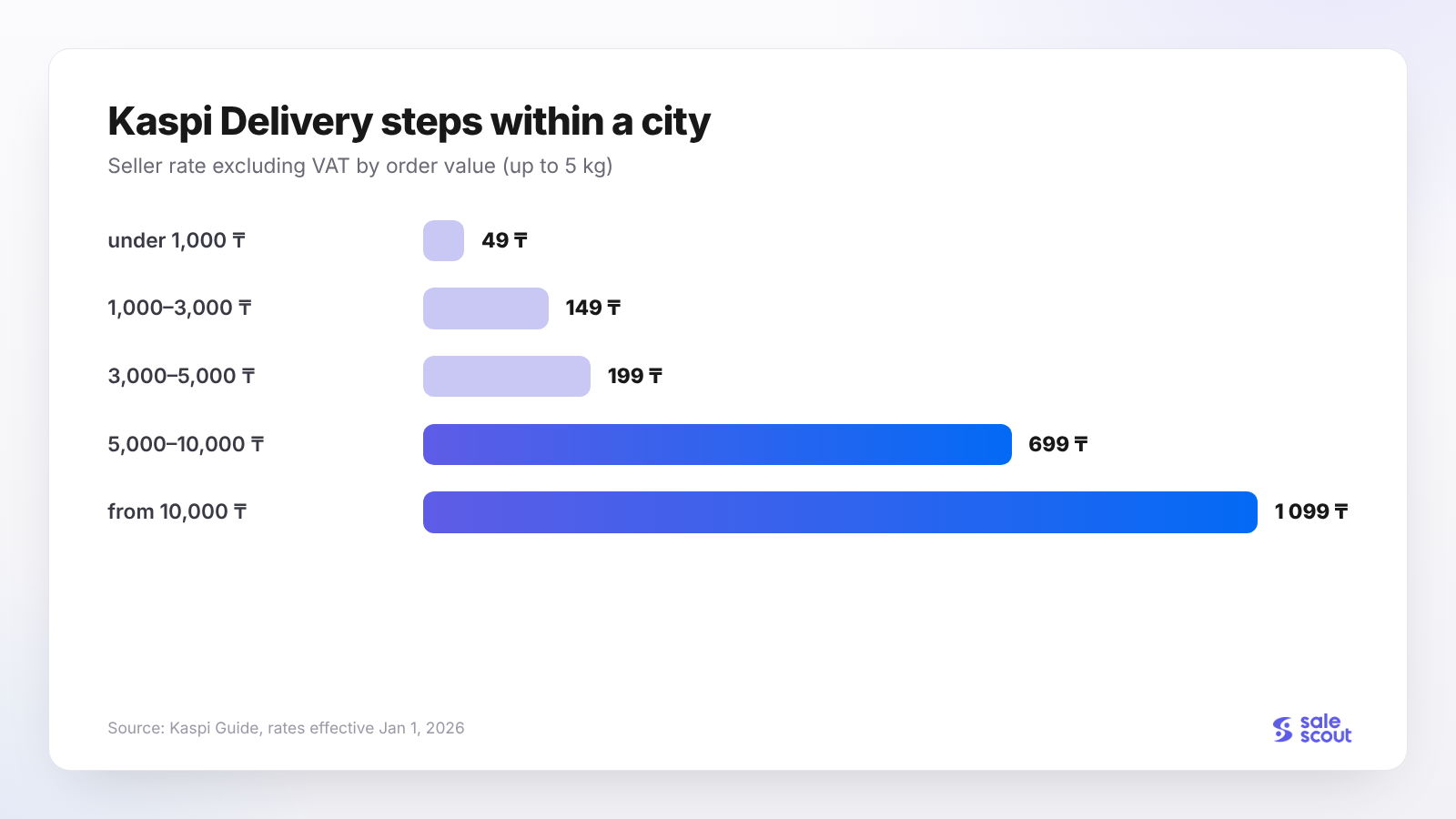
Kaspi charges sellers for delivery based on order value, weight and route (Kaspi Guide, "How much does Kaspi Delivery cost", rates effective January 1, 2026). For orders under 10,000 ₸ the rate depends only on the order value; from 10,000 ₸ it depends on weight. Excluding VAT, it looks like this:
| Order value | Within city | Across Kazakhstan | Incl. 16% VAT, within city |
|---|---|---|---|
| under 1,000 ₸ | 49 ₸ | 49 ₸ | ≈ 57 ₸ |
| 1,000–3,000 ₸ | 149 ₸ | 149 ₸ | ≈ 173 ₸ |
| 3,000–5,000 ₸ | 199 ₸ | 199 ₸ | ≈ 231 ₸ |
| 5,000–10,000 ₸ | 699 ₸ | 799 ₸ | ≈ 811 ₸ |
| from 10,000 ₸, up to 5 kg | 1,099 ₸ | 1,299 ₸ | ≈ 1,275 ₸ |
It's charged with VAT and only after the order has been handed to the customer. The VAT rate from 2026 is 16% (Article 503 of the Tax Code).
What this means in practice is shown in the hypothetical example below.
VAT on top of the fee
Since January 5, 2026, Kaspi shows the fee excluding VAT and charges the tax separately (Kaspi Guide). For most categories that's 10.9% excluding VAT and 12.5% including VAT per the official fee schedule. An individual entrepreneur (IP) on the simplified regime who isn't registered for VAT can't offset this tax. Your calculation should use the "incl. VAT" column, not the number printed large in the seller cabinet.
Returns
Under the Kaspi Store rules, a seller can't refuse a return of goods of proper quality within 14 calendar days of purchase if the item's condition is preserved (Kaspi.kz Store rules, clause 4.3). A return eats more than the revenue: delivery has already been paid, packaging is ruined, and sometimes the item has to be marked down. Calculate the returns reserve from your own 90-day history for each category, not as a single figure for the whole store.
Track quality-related returns separately. Kaspi requires keeping them below 2%, otherwise restrictions are possible, up to disconnection from the platform (Kaspi Guide, "Why was I disconnected"). High returns hit you twice: in money and across the whole store.
Installment promotions
During 0-0-24 installment promotions (0% interest, no down payment, 24 months), the fee may differ from the usual one (Kaspi Guide, "What is the sales fee"). Before joining, open the terms in the seller cabinet (Marketing → Promotions) and recalculate your minimum price for the promotional fee. Your old minimum price can easily turn loss-making in a promotion.
Tax on turnover, not profit
Under the simplified declaration regime, the base rate in 2026 is 4%, but each maslikhat (local council) may shift it within a 2–6% corridor (BES.media). Astana and Almaty set 3%, Shymkent 2%. Expenses aren't deducted; the tax is taken from all revenue. When you make one and a half thousand on a 10,000 ₸ kettle, 300 ₸ of tax is a fifth of your profit, hardly small change.
Example: how +100 ₸ on the price reduces profit
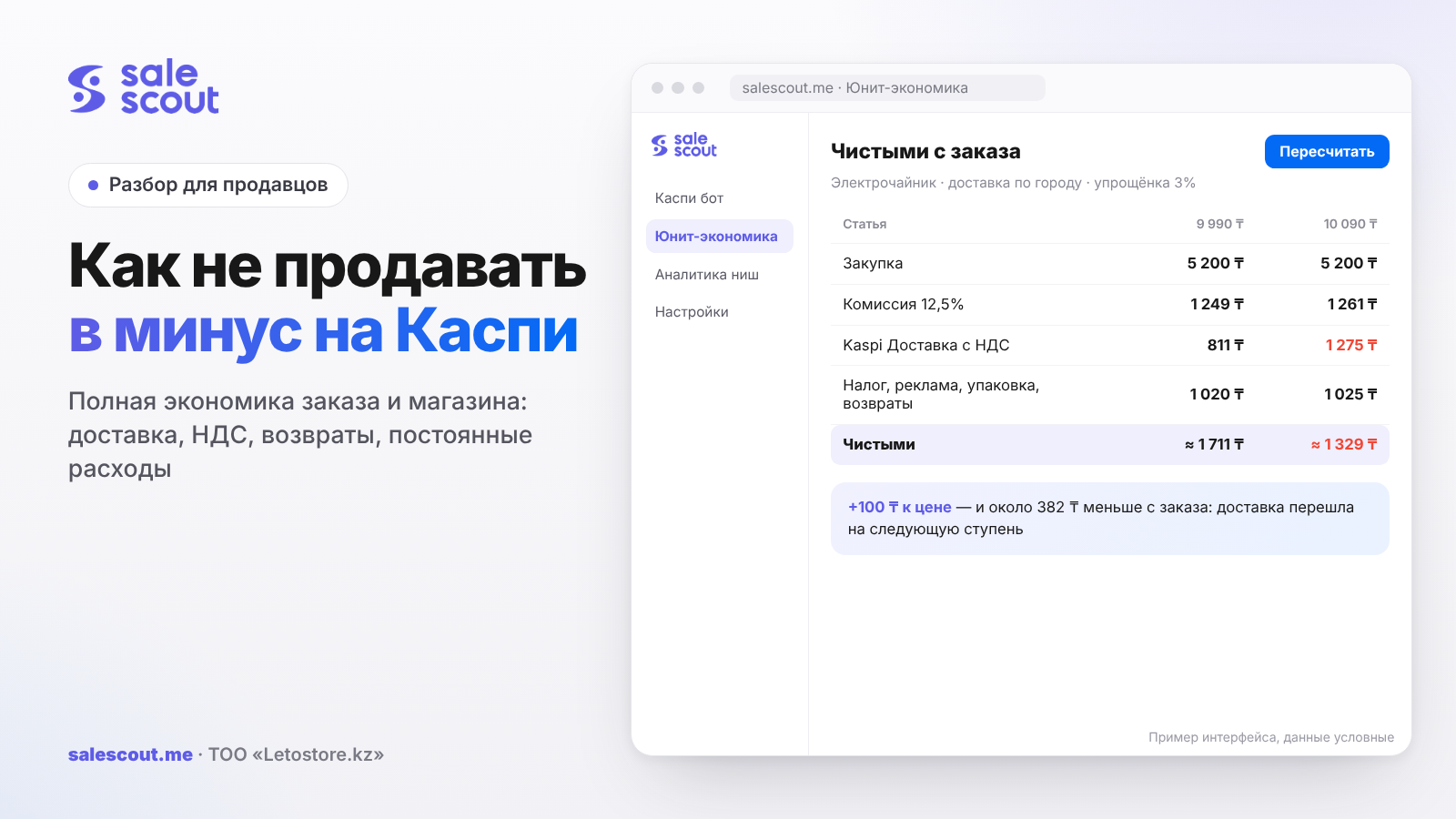
A hypothetical example, not a client case. Take an electric kettle in the "Appliances" category with a 12.5% fee including VAT; it's sold by an individual entrepreneur (IP) in Almaty on the 3% simplified regime, with in-city delivery and a weight under 5 kg. We took the purchase cost of 5,200 ₸, advertising of 400 ₸ per order, packaging of 120 ₸ and a 2% returns reserve as rough figures; plug in your own.
| Item | Price 9,990 ₸ | Price 10,090 ₸ |
|---|---|---|
| Purchase cost | 5,200 ₸ | 5,200 ₸ |
| Fee 12.5% | 1,249 ₸ | 1,261 ₸ |
| Kaspi Delivery incl. VAT | 811 ₸ | 1,275 ₸ |
| Tax 3% | 300 ₸ | 303 ₸ |
| Advertising | 400 ₸ | 400 ₸ |
| Packaging | 120 ₸ | 120 ₸ |
| Returns 2% | 200 ₸ | 202 ₸ |
| Net per order | ≈ 1,711 ₸ | ≈ 1,329 ₸ |
The price went up by 100 ₸, and profit fell by about 382 ₸. The reason is delivery moving to the next step. To earn the same 1,711 ₸ at a price above 10,000 ₸, you'd need to charge about 10,553 ₸. So the range from roughly 10,000 to 10,550 ₸ is a dead zone for this product: there you earn less than at 9,990 ₸.
It works the other way too. You're at 10,300 ₸ and a competitor has been dragging the card down for the third day: sometimes it's more honest to jump straight to 9,990 ₸ than to cling painfully to 10,050 ₸. Calculate both options before deciding.
Fixed costs: a share for every order
Besides purchase cost, fees and delivery, there's money that goes out every month regardless of sales: a packer's salary, warehouse rent, an accountant, subscriptions, the IP's own social contributions. Someone has to pay for those too, and that someone is your orders. The crudest method that still works:
Fixed costs per order = Store's monthly fixed costs ÷ Number of orders per month
Say (the numbers are hypothetical) fixed costs come to 600,000 ₸ a month, with 1,200 orders. That means each order carries 500 ₸. A product that leaves 400 ₸ looks profitable in the spreadsheet. In reality, every sale of it takes a hundred off the month's total.
You don't have to drop it tomorrow: sometimes a cheap fast-moving item brings in customers and reviews. Just keep it deliberately, and put a date in your calendar for when you'll revisit the question.
Building target profit into the minimum price
There are two options. The first is to build the share of fixed costs right into the "target profit" of the minimum price formula. The minimum price goes up, but neither the bot nor a manager on a Friday evening will drop the product to where it stops feeding the store. The second is to calculate the minimum price on variable costs only and cover rent and salaries with high-margin items. The first is safer for a new store. The second is more flexible, but without a monthly check of the totals it's easy to miss that the high-margin items no longer cover them.
Cash in circulation
It also happens that everything is in the black on paper, but there's no money to pay the supplier. You paid for the stock before it even arrived from China, and Kaspi transfers the money only after the customer collects the order. Between those two dates come shipping, some weeks on the shelf and delivery.
Turnover in days = Average stock at purchase prices ÷ Purchase cost of goods sold per day
If one product turns over in 45 days with 8% profit per order and another in 10 days with 5%, the second may bring in more money per tenge invested over a quarter, because the money has time to turn over several times. Run this on your own data before buying a "high-margin" product in a large batch.
ABC analysis: where the store loses money
Once a month, export your orders and calculate the monthly net profit for each SKU. A hypothetical table for five products:
| SKU | Orders | Net per order | Monthly total | Fixed-cost share (500 ₸ × orders) | Result |
|---|---|---|---|---|---|
| A | 300 | 1,700 ₸ | 510,000 ₸ | 150,000 ₸ | +360,000 ₸ |
| B | 250 | 900 ₸ | 225,000 ₸ | 125,000 ₸ | +100,000 ₸ |
| C | 400 | 450 ₸ | 180,000 ₸ | 200,000 ₸ | −20,000 ₸ |
| D | 150 | 300 ₸ | 45,000 ₸ | 75,000 ₸ | −30,000 ₸ |
| E | 100 | −120 ₸ | −12,000 ₸ | 50,000 ₸ | −62,000 ₸ |
Look at C (all the numbers are made up for the example): it has the most orders, the manager is proud of it, and it doesn't cover its share of costs. E is even worse: it loses money already at the order level. Drop E, raise the minimum price on C and D, and it may well turn out that turnover fell while the money went up.
What to do with loss-making products
A product losing money already at the order level? First double-check the spreadsheet: often the culprit is forgotten shipping to the warehouse or an old exchange rate. If the loss is confirmed and the market won't let you go higher, you need a cheaper supplier, or you'll have to leave the card.
When the order is in the black but goes negative after fixed costs, you have more levers: raise the minimum price, switch off ads on that item, check whether the price is sitting right above a delivery threshold.
And if a product is profitable but sits for months, leave the price alone. Just order a smaller next batch and don't put ad budget into it.
How to set up control
Weekly
Half an hour a week is enough. Look at how much your top twenty products made net. Compare the purchase cost in recent deliveries with what's entered in the spreadsheet: suppliers rarely warn you about price increases in advance. And scroll through quality returns and cancellations: if there are more of them, it's better to find out now than from a letter from Kaspi.
Monthly
The monthly work is longer; it'll take an evening. That's the ABC analysis with the share of fixed costs described above, plus new minimum prices for products whose purchase cost, weight or advertising changed. And Kaspi's rates: in 2026 both the fee and delivery have already changed.
Once a year and when legislation changes
At the end of November, check your maslikhat's decision: the simplified-regime rate for the next year is approved before December 1, and all your minimum prices from January depend on it. Incidentally, it's worth going through your service subscriptions at least once a year too; they pile up unnoticed.
Common mistakes
- Calculating profit only at the order level. Without the fixed-cost share, "profitable" products quietly eat the month's result.
- Pricing just above 10,000 ₸. Delivery jumps to the next step, and profit falls more than the price rises.
- Using the fee excluding VAT. The number in the cabinet is big and neat, but if you don't pay VAT, your real cost is about 1.5–2 percentage points of the price higher.
- One returns reserve for all products. Sized clothing and consumables have different return rates, and a single percentage distorts both categories.
- Not recalculating the price for promotions. In installment promotions the fee may differ, and your usual minimum price stops working.
- Confusing profit with cash. The product is profitable but sits for half a year, and when you need to pay for a new batch, there's no money in the account.
- Entering the supplier's price as purchase cost. Without delivery to the warehouse, import payments, exchange rate and defects, the cost is understated, and so is the minimum price.
- Not removing loss-making SKUs. "Let it sit, it doesn't eat anything" — it certainly does: ads, the manager's time and warehouse shelf space.
Checklist: a store without losses
The most important thing here is cost of goods. If it's calculated from the supplier's invoice, without shipping to the warehouse, import costs, exchange rate and defects, every other item is built on an understated number. So start with it, then go through the rest:
- Profit per order for each SKU is calculated with every cost item, including VAT on the fee and delivery.
- Prices around 10,000 ₸ are checked on both sides of the delivery threshold.
- The returns reserve is set per category, based on 90 days of history.
- Quality returns are below 2%, cancellations due to your fault below 3%.
- You know how much in fixed costs falls on each order.
- For every loss-making SKU, the ABC analysis led to a decision, not a "we'll see".
- The minimum price was recalculated after a new delivery.
- You read the terms of the installment promotion before joining it.
- The tax rate is checked against this year's maslikhat decision.
- Turnover speed is known for your top twenty products.
How to automate it
Everything above is calculated in a spreadsheet, and automation won't help with that. What it can help with is keeping the price in the card within those calculations when a competitor starts dumping on Saturday night. SaleScout's Kaspi bot checks prices every 20 seconds and never goes below the minimum price you set. If a competitor goes up or leaves the card, the bot raises your price too. If your minimum price is calculated with every cost item from this article, it won't take the product into a loss. You can try it free for 7 days, no card required.
FAQ
Why am I selling at a loss on Kaspi if my price is above the purchase cost?
Because between the purchase cost and the price sit the Kaspi fee including VAT, Kaspi Delivery, tax, advertising, packaging and returns. In our hypothetical kettle example, together they take about 31% of the price. Add the store's fixed-cost share, and a product with a "30% markup" can be losing money.
How does the 10,000 ₸ threshold affect profit on Kaspi?
A lot: at this threshold, in-city delivery jumps from 699 ₸ to 1,099 ₸ excluding VAT (for items up to 5 kg). So 10,090 ₸ can bring in less money than 9,990 ₸. Calculate any price near the threshold both ways.
Do I need to account for VAT on the Kaspi fee if I'm an individual entrepreneur on the simplified regime?
Yes, if you're not a VAT payer. Since 2026, Kaspi shows the fee excluding VAT and adds the tax on top, and you can't offset it. For most categories, use 12.5% instead of 10.9% in your calculations.
How do I account for fixed costs in a product's price on Kaspi?
Divide the store's monthly fixed costs by the number of orders per month to get the share per order. A product has to bring in more than that share per order, otherwise it reduces the month's result. You can include the share in the target profit when calculating the minimum price.
How often should I recalculate product profit on Kaspi?
Your top twenty products are convenient to review weekly, the whole assortment monthly. The minimum price is better recalculated when something happens: a new purchase arrives, Kaspi changes its rates, you join an installment promotion, the tax rate changes.
What should I do with a product that sells at a loss?
It depends where the loss is. If it's already at the order level, recalculate the minimum price with all costs, and if the market won't let you go higher, look for a cheaper supplier or leave the card. If the loss appears only after fixed costs, switching off ads and raising the minimum price is usually enough.
Sources
All links checked Oct 15, 2026. The sources are in Russian; original titles are given with English translations.
- Kaspi Guide for partners. «Сколько стоит Kaspi Доставка?» ("How much does Kaspi Delivery cost?") — https://guide.kaspi.kz/partner/ru/shop/delivery/shipping/q2288 (updated Jun 16, 2026)
- Kaspi Guide for partners. «Что поменялось в расчёте комиссии с 5 января 2026 года?» ("What changed in fee calculation from January 5, 2026?") — https://guide.kaspi.kz/partner/ru/shop/conditions/q4467
- Kaspi. Тарифы Магазина на Kaspi.kz 2026 ("Kaspi.kz Store fees 2026", PDF) — https://guide.kaspi.kz/cdn/content/pay/product/documents/Magazin/Tarify_Magazina_na_Kaspi_kz_2026.pdf
- Kaspi Guide for partners. «Какая комиссия за продажи в Магазине на Kaspi.kz?» ("What is the sales fee in the Kaspi.kz Store?") — https://guide.kaspi.kz/partner/ru/shop/conditions/q1344
- Kaspi Guide for partners. «Какие правила работы с Магазином на Kaspi.kz?» ("What are the rules for working with the Kaspi.kz Store?") — https://guide.kaspi.kz/partner/ru/shop/conditions/q1342 (updated Sep 30, 2026)
- Kaspi Guide for partners. «Почему меня отключили от Магазина на Kaspi.kz?» ("Why was I disconnected from the Kaspi.kz Store?") — https://guide.kaspi.kz/partner/ru/shop/conditions/q2920
- Tax Code of the Republic of Kazakhstan, Article 503 — https://www.zakonpravo.kz/ru/statya-503-stavki-naloga-na-dobavlennuyu-stoimost-nalogovogo-kodeksa-respubliki-kazahstan
- BES.media. «В регионах Казахстана снизили налог по „упрощёнке“ на 2026 год» ("Kazakhstan's regions cut the simplified-regime tax for 2026") — https://bes.media/news/v-regionah-kazahstana-snizili-nalog-po-uproshyonke-na-2026-god/
Bota, SaleScout analyst
This article is for information only and does not replace calculations by your accountant. SaleScout is our company's product. Kaspi and Kaspi.kz are trademarks of Kaspi.kz JSC; SaleScout is not affiliated with Kaspi.