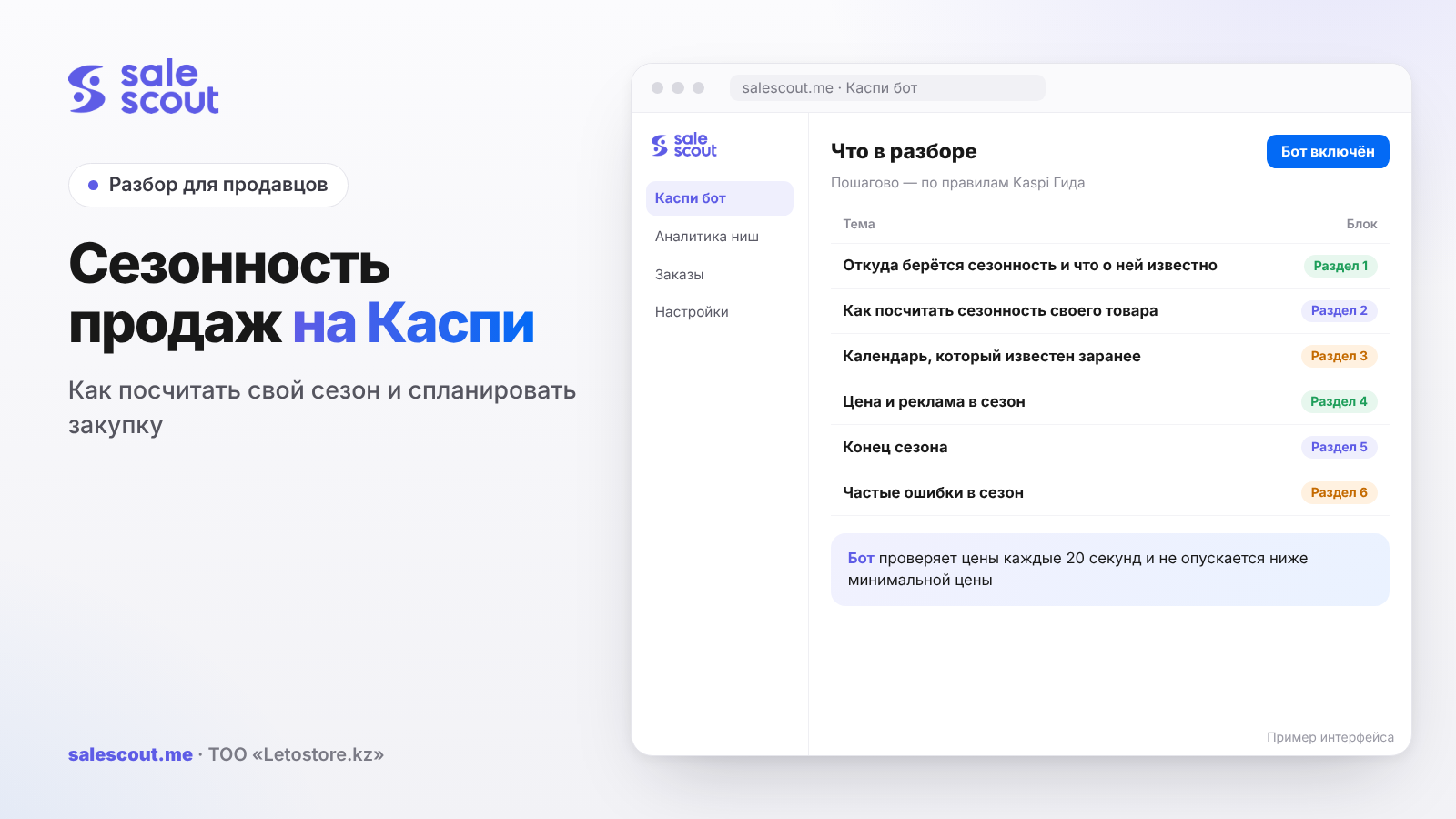
Sales seasonality on Kaspi differs for every product, and Kaspi does not publish official monthly demand statistics. So you calculate your season from your own orders for the past year: divide each month's sales by the average and you get a seasonality index. On top of it sit two calendars known in advance: Kazakhstan's public holidays and the three Kaspi Жұма (Kaspi Zhuma) events a year, in February, June and November.
In short
- Kaspi has no ready-made seasonality data by category. You have your own orders for the year, and that is enough for the calculation.
- Seasonality index = month's sales ÷ average monthly sales. An index of 2.5 means that this month sells two and a half times more than usual.
- Purchasing for the peak is calculated from last year's month adjusted for your current growth, not from the sales of the last few weeks.
- The most dangerous purchase is the last one of the season: stock bought at the peak sells several times slower in the off-season.
- You may not raise the price "to match demand" before promotions and Zhuma; Kaspi prohibits this directly.
Where seasonality comes from and what is known about it
What Kaspi publishes and what it doesn't
Kaspi does not disclose demand by month, category or region. The Guide for partners contains only general estimates for promotions: during Store promotions partners' sales usually grow more than 2 times (q1675), during Kaspi Zhuma more than 5 times (q2180). These are averages across all partners, including offline points, and they apply poorly to your specific product card.
So there are two working sources. The first is your own orders from previous periods. The second is calendars known in advance: holidays set by law, Store promotions and Zhuma. Everything else you read about "demand peaks on Kaspi in such-and-such month" is someone's observations without data.
Three kinds of seasonality for a seller
It helps to separate three things, because you prepare for them differently.
Product season is when a product is needed by its very nature. Heaters and sleds in winter, air conditioners and pools in summer, backpacks and stationery before the school year. It lasts for months, and purchasing for it is planned in advance.
Holiday peaks are short spikes before dates such as March 8, Nauryz or New Year. They last for days, and the main risk is not running out of stock but the warehouse and delivery on days off.
Promotion peaks are Store promotions and Kaspi Zhuma. Their dates are known in advance, and the growth, according to Kaspi, is a multiple. How to prepare for them is covered in detail in the article on Kaspi Zhuma for sellers.
How to calculate your product's seasonality
Seasonality index
For the calculation you need monthly sales for at least 12 months. It is better to count in units, not in tenge: the price may have changed over the year, while units show demand more honestly.
Month index = month's sales ÷ (sales for 12 months ÷ 12)
An index of 1.0 is a normal month, 2.5 is a peak, 0.1 is a dead season. A hypothetical example, not a client case: a heater's sales last year by month, in units.
| Month | Sold, units | Index |
|---|---|---|
| January | 60 | 2.12 |
| February | 45 | 1.59 |
| March | 20 | 0.71 |
| April | 8 | 0.28 |
| May | 4 | 0.14 |
| June | 2 | 0.07 |
| July | 2 | 0.07 |
| August | 4 | 0.14 |
| September | 12 | 0.42 |
| October | 35 | 1.24 |
| November | 70 | 2.47 |
| December | 78 | 2.75 |
| Total | 340 | 28.33 per month on average |
Two things are visible right away. The peak runs from November to January, three months with an index above two. And the drop after January is steep: in March the product sells three times slower than in January. For planning, the second matters more than the first.
Adjusting for growth and data traps
Last year rarely repeats exactly. A simple adjustment is the growth factor g: sales for the last two months of this year ÷ sales for the same months last year. In our example, 12 + 35 = 47 units sold in September and October last year, and 56 this year. So g = 56 ÷ 47 ≈ 1.19.
There are three traps here. If the product was off sale for a week last year because it ran out, that month's index is understated: you are seeing stock, not demand. If in some month last year you were not at the top of the product card, the sales reflect your position, not the season. And if the month coincided with a promotion or Zhuma, the spike belongs to the promotion, not to the product's season. It is better to flag such months and leave them out of the g calculation.
Purchasing formula for the peak
Purchase = (forecast for the peak months) × 1.15 − warehouse stock − goods in transit, where a month's forecast = sales in the same month last year × g, and 1.15 is a 15% safety stock.
Let's continue the example. November: 70 × 1.19 ≈ 83 units, December: 78 × 1.19 ≈ 93 units. There are 30 in the warehouse.
| Step | Calculation | Result |
|---|---|---|
| Forecast for November and December | 83.4 + 92.9 | 176.3 units |
| With a 15% buffer | 176.3 × 1.15 | 203 units |
| Minus warehouse stock | 203 − 30 | 173 units to order |
January is deliberately left out of this purchase. It is better to decide on it at the start of December, when you can see whether November matched the forecast. But if the supplier takes a month to deliver, the January order has to go out no later than the start of December, and the date of that decision is worth putting in the calendar right now. How to calculate the reorder point given the supply lead time we covered in the article on stock levels on Kaspi.
The calendar known in advance
Kazakhstan's public holidays
Holidays are set by the law "On Holidays in the Republic of Kazakhstan" (as amended on Jul 1, 2026, zakon.uchet.kz). The list has changed since July 1, 2026, so check older calendars against the current edition.
| Holiday | Date by law | What matters for a seller |
|---|---|---|
| Republic Day (national holiday) | October 25 | in 2026 it is a Sunday, the day off moves to Monday, October 26 |
| Independence Day | December 16 | in 2026 it is a Wednesday, the middle of the working week |
| New Year | January 1–2 | in 2027 they fall on Friday and Saturday |
| International Women's Day | March 8 | the gift is needed by the date, allow for delivery time |
| Constitution Day | March 15 | in the edition of the law from Jul 1, 2026 |
| Nauryz meirami | March 21–23 | three public holidays in a row |
| Day of Unity of the People of Kazakhstan | May 1 | — |
| Defender of the Fatherland Day | May 7 | the gift is needed by the date, allow for delivery time |
| Victory Day | May 9 | — |
| Capital Day | July 6 | — |
Public holidays are non-working days, and if a holiday falls on a day off, the next working day after the holiday becomes a day off (Article 5 of the law). The government can additionally move days off, so check the final schedule for the year in the resolution on transferring days off.
What this means for orders and delivery
Orders on Kaspi arrive on weekends and holidays too. You can process them on the nearest working day according to the schedule you set in the cabinet, and the handover deadline is shown in the order (q2789). For the deadline to be calculated fairly, the holiday must be entered under Настройки → «Расписание в праздники» ("Settings → Holiday schedule") and marked as a day off or given different hours (q2787).
The working hours of Kaspi.kz drop-off points are shown on the map, separately for each point (q2788). Before long holidays, such as the three days of Nauryz, check your point in advance, not on the morning of the first working day.
Gift dates such as March 8 and May 7 are a separate story. The logic is simple: the gift is needed for the holiday, not after it. Kaspi Delivery within a city takes one day on average from handover at the drop-off point, and two to three days to regional cities (q2291). A product the buyer wants to receive by March 8 in another city has to leave you several days earlier.
Store promotions and Kaspi Zhuma
The Store promotion calendar is open in Kaspi Pay: Маркетинг → Акции Магазина на Kaspi.kz ("Marketing → Kaspi.kz Store promotions"). Kaspi warns that it is updated regularly, and the type and terms of each promotion are shown there as well (q1672). Kaspi Zhuma takes place three times a year, in February, June and November, and lasts four days; the November 2026 event runs from November 5 to 8 (q3761).
If your season and Zhuma coincide, as with winter products in November, the peaks add up. You cannot calculate this with the index: last year's November figure already has Zhuma inside it. So for November it is better to take the forecast with a buffer and decide in advance what to do if the product runs out in the middle of the promotion.
Price and advertising during the season
You may not raise the price for a promotion
In the run-up to and during Store promotions and Kaspi Zhuma, unjustified price increases are prohibited. The exception is a rise in the purchase cost, and Kaspi has the right to request documents. Violators are removed from the promotion and may not be admitted to the next ones (q1678, q2182).
For a seasonal product this means that "raising the price because everyone is buying" in November is a risk. If purchasing for the season really is more expensive, keep the supplier's invoices. If not, hold the price and earn on volume.
Competition in the product card changes with the season
At the peak, sellers who trade this product only seasonally may enter the card, and the price at the top starts changing more often. How many of them you will get is visible only in the card itself: Kaspi does not publish such statistics. Either way, there is one limit — your minimum price, below which a sale goes into the red. Its formula is in the article on dumping on Kaspi. During the season it is worth recalculating it with the current purchase cost: the new batch may have arrived at a higher price.
Advertising in Kaspi Маркетинг (Kaspi Marketing) also gets more or less expensive during the season along with competition, but there is no public data on seasonal bids. Look at your cost per click in the previous peak and compare it with the profit per order; how to calculate this is covered in the article on the cost-per-click bid in Kaspi Marketing.
End of the season: when to stop purchasing
The last purchase is the most expensive
Back to the heater. Say there are 40 units left in the warehouse at the end of February. By the forecast with g = 1.19, about 24 will sell in March, about 10 in April and about 5 in May. So the last units will go by summer, and all that time they have already been paid for.
Hence a simple rule: the last purchase of the season is calculated not from current sales but from the index of the following months. In January, when the product is flying off the shelves, it is easy to buy "the same amount again", forgetting that March's index is three times lower than January's.
Preorders as a way not to freeze money
If the supplier is ready to bring the product to order, you can sell it before it reaches the warehouse via a preorder. The maximum term is 30 calendar days, it is set only via the price list in the web cabinet, and manually editing the price or stock in the card cancels the preorder (q3346, updated Aug 13, 2026). For the tail of the season this is a way not to keep the product in the warehouse but to order it against real orders. More in the article on preorders on Kaspi.
Common mistakes during the season
- Forecasting from the last two weeks. At the start of the peak, sales grow every week, and a "same as now" forecast understates the peak. A calculation from last year's month with the g adjustment is more accurate.
- Counting a month when the product was out of stock. If the product ran out on the 10th last December, December's index shows stock, not demand. A purchase based on it will be smaller than needed.
- Confusing a promotion spike with the season. November with Zhuma and November without it are different months. When carrying last year's November over to this year, check when Zhuma took place.
- Raising the price "for the season" before a promotion. Kaspi prohibits unjustified price increases before promotions and Zhuma. Losing access to future promotions over a seasonal markup is a bad deal.
- Not entering holidays into the schedule. If the warehouse is closed for Nauryz but the cabinet treats those days as working days, orders from those days end up as delays and cancellations.
- Buying "the same amount again" at the peak. Two months later the index may be three times lower. The last batch of the season can easily sit until summer.
- Shipping gifts at the last minute. Kaspi Delivery to a regional city takes two to three days on average. An order handed over on the eve of March 8 will not arrive in time for the holiday.
Checklist: preparing for the season on Kaspi
- Monthly sales for 12 months are exported in units for each key SKU.
- Months when the product was out of stock or a promotion was running are flagged.
- Indexes and the growth factor g for the last two months are calculated.
- Purchasing for the peak is calculated by the formula with a 15% buffer and goods in transit.
- The date of the purchasing decision for the next peak month is in the calendar, allowing for the supply lead time.
- All holidays of the next three months are entered in «Расписание в праздники».
- The holiday hours of your drop-off point are checked on the map.
- The minimum price is recalculated with the purchase cost of the new batch.
- Documents on the higher purchase cost are kept if you raise the price before a promotion.
- For the tail of the season you have decided what to sell from the warehouse and what via preorder.
You don't have to run the checklist for the whole catalog. Usually there are few seasonal SKUs that carry the peak revenue, and it is worth doing the calculation for those.
How to automate work during the season
You calculate the seasonality index and purchasing yourself, while SaleScout niche analytics helps you see which niches are growing at all: it shows what to sell on Kaspi. At the peak itself, you can hand the price in the card to the SaleScout Kaspi bot: it checks prices every 20 seconds, keeps you at the top of the card and never goes below the minimum price you set. When a competitor raises their price or leaves the card, the bot raises your price to just below the next seller. You can try the bot free for 7 days, no card needed.
Frequently asked questions about sales seasonality on Kaspi
Does Kaspi have sales seasonality statistics?
No, Kaspi does not publish demand by month and category. The Guide contains only general estimates for promotions: partners' sales grow more than 2 times during Store promotions and more than 5 times during Kaspi Zhuma. You calculate your product's seasonality from your own orders.
How do I calculate sales seasonality on Kaspi?
Take monthly sales for 12 months in units and divide each month by the average monthly sales. You get an index: 1.0 is a normal month, above 2 is a peak. It is better to flag separately the months when the product was out of stock or a promotion was running.
How do I plan purchasing for the season on Kaspi?
The forecast for a peak month is the sales of the same month last year multiplied by your current growth. Add up the peak months, add a 15% buffer and subtract stock and goods in transit. For example, 83 + 93 units with the buffer give 203, minus 30 in the warehouse leaves 173 to order.
When does Kaspi Zhuma take place?
Three times a year: in February, June and November, four days each. The November 2026 event runs from November 5 to 8. If your season coincides with Zhuma, the peaks add up, so it is better to plan stock with a buffer.
Can I raise the price during the season on Kaspi?
Outside promotions you set the price yourself. But in the run-up to and during Store promotions and Kaspi Zhuma, unjustified increases are prohibited. The exception is a higher purchase cost, and Kaspi has the right to request documents.
Do I have to work on holidays if I sell on Kaspi?
Not necessarily. Orders arrive on holidays too, but you can process them on the nearest working day if the holiday is entered in «Расписание в праздники» as a day off. Then the handover deadline in the order is counted from the working day.
What should I do with stock at the end of the season?
Calculate the last purchase from the indexes of the following months, not from current sales. The tail of the season can be sold via preorder with a term of up to 30 days, so you don't keep the product in the warehouse.
Sources
All links checked Oct 19, 2026. The sources are in Russian; original titles are given with English translations.
- Law of the Republic of Kazakhstan No. 267 of December 13, 2001 «О праздниках в Республике Казахстан» (On Holidays in the Republic of Kazakhstan), edition with amendments as of Jul 1, 2026 — https://zakon.uchet.kz/rus/docs/Z010000267_ (legal information system, copy of adilet.zan.kz)
- Kaspi Guide for partners. «На сколько вырастут мои продажи в период акции в Магазине на Kaspi.kz?» (How much will my sales grow during a Store promotion?) — https://guide.kaspi.kz/partner/ru/marketing/campaign_shop/q1675 (updated Feb 16, 2024); «Где посмотреть календарь акций Магазина на Kaspi.kz?» (Where can I see the Store promotion calendar?) — https://guide.kaspi.kz/partner/ru/marketing/campaign_shop/q1672 (updated Jul 12, 2024); «Можно поднять цены на товары в период акции…?» (Can I raise prices during a promotion?) — https://guide.kaspi.kz/partner/ru/marketing/campaign_shop/q1678 (updated Nov 21, 2024)
- Kaspi Guide. «На сколько вырастут мои продажи в период Kaspi Жұма?» (How much will my sales grow during Kaspi Zhuma?) — https://guide.kaspi.kz/partner/ru/zhuma/q2180 (updated Oct 8, 2026); «Сколько будет длиться Kaspi Жұма?» (How long will Kaspi Zhuma last?) — https://guide.kaspi.kz/partner/ru/zhuma/conditions/general/q3761 (updated Oct 9, 2026); «Можно поднять цены на период Kaspi Жұма?» (Can I raise prices for Kaspi Zhuma?) — https://guide.kaspi.kz/partner/ru/zhuma/q2182 (updated Oct 9, 2026)
- Kaspi Guide. «Я буду получать заказы в выходные и праздничные дни…?» (Will I receive orders on weekends and holidays?) — https://guide.kaspi.kz/partner/ru/shop/orders/q2789 (updated Sep 27, 2023); «Как… настроить график работы в праздничные дни?» (How to set the holiday schedule?) — https://guide.kaspi.kz/partner/ru/shop/sale_points/q2787 (updated Mar 28, 2025); «Какой режим работы пунктов приема Kaspi.kz?» (What are the hours of Kaspi.kz drop-off points?) — https://guide.kaspi.kz/partner/ru/shop/delivery/shipping/q2788 (updated May 6, 2025)
- Kaspi Guide. «Какие сроки у Kaspi Доставки?» (What are Kaspi Delivery times?) — https://guide.kaspi.kz/partner/ru/shop/delivery/shipping/q2291 (updated Jul 31, 2024); «Что такое предзаказ товара…?» (What is a product preorder?) — https://guide.kaspi.kz/partner/ru/shop/goods/general/q3346 (updated Aug 13, 2026)
Bota, analyst
SaleScout is our company's product. Kaspi and Kaspi.kz are trademarks of Kaspi.kz JSC; SaleScout is not affiliated with Kaspi.