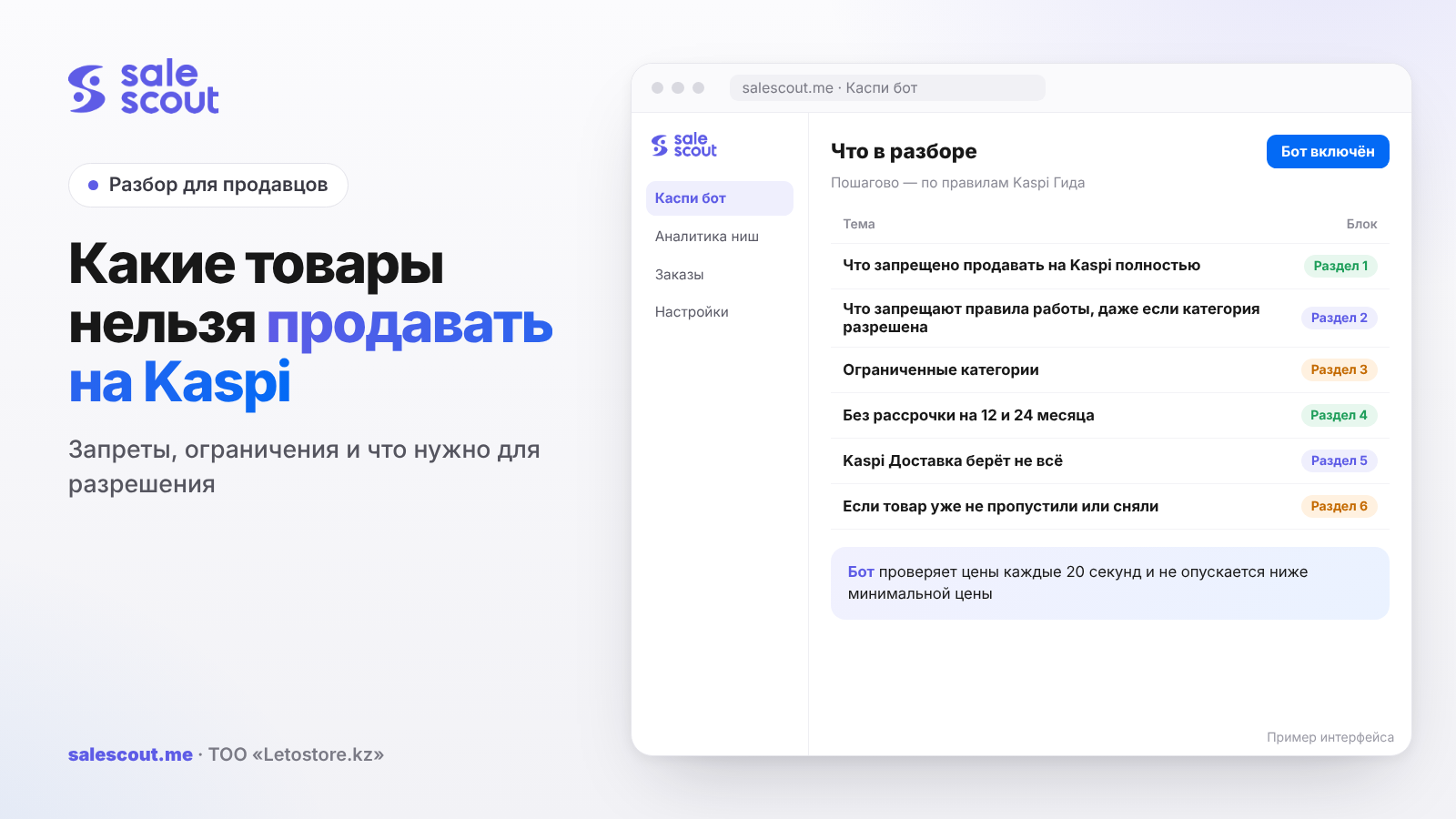
On Kaspi you can't sell used goods and fakes, weapons, smoking products, anything marked 18+, subscriptions and keys, cosmetic samples or live animals at all — and that's far from the whole list. Children's goods, pharmacy items, cosmetics, dietary supplements, fireworks and jewellery can be sold, but Kaspi will ask for documents first. And household chemicals, pet food and shampoos are sold without 12- and 24-month installments. Below are all three lists from the Kaspi Guide (Kaspi's official help centre) and what to check before you pay a supplier.
In short
- Fully banned: used goods, replicas, brass knuckles, hookahs, hidden cameras, activation keys, samples, animals and uniforms of the security services.
- Expired goods and unpacked display items are banned by the store rules, not by the category list.
- Restricted categories need a supplier contract, an invoice, proof of payment and, where the law requires it, an EAC certificate or declaration.
- Household chemicals, pet food, baby food and part of personal hygiene can't be sold in 12- and 24-month installments.
- A product price on Kaspi is from 10 ₸ to 5 million ₸.
What is completely banned on Kaspi
The list in the Kaspi Guide is short but broad (q3904, updated Jan 16, 2026). The ban covers both selling and advertising:
| Group | Examples from the Guide |
|---|---|
| Used goods, fakes, replicas | anything second-hand and copies of brands |
| TV and radio broadcasting | equipment that receives operators' signals without a licence |
| Religious rites | literature, prayer mats |
| Banned symbols and offensive images | obscene slogans, propaganda of violence and drugs |
| Dangerous to people and animals | smoking products, weapons, brass knuckles, telescopic batons, training shockers |
| 18+ | anything with this label |
| Spy purposes | hidden cameras, high-frequency microphones |
| Digital goods | subscriptions, software activation keys |
| For free distribution | cosmetic samples |
As separate lines, the Guide bans animals, uniforms of the military, law enforcement and the tax service of Kazakhstan, as well as synthetic fishing nets with a mesh under 100 mm and a thread thinner than 0.5 mm.
Why? In some cases Kazakhstan law stands in the way, in others the goods can only be transported under a licence or in special conditions, and in others it comes down to technology. Kaspi's explanation is brief, and nobody has yet won an argument about it through support.
Borderline cases that trip people up
Hookahs and e-cigarettes usually raise no questions: they fall straight under "smoking products". Hidden cameras are trickier: a pen or key fob with a built-in camera looks like a household trinket, but the Guide classes items with hidden cameras as spy gear. A Windows key or a streaming subscription is a digital product, even if you print it on a card and put it in a box.
Samples are a particular pain for cosmetics stores. A mini version of a cream that the manufacturer releases "not for sale" won't get through on Kaspi. More on cosmetics in how to sell cosmetics on Kaspi.
What the store rules ban even when the category is allowed
Some bans concern not the type of product but its condition. They are written in the rules for the Kaspi.kz Store, section 3 «Качество товара» ("Product quality") (q1342, updated Sep 30, 2026). You may not:
- sell unpacked goods that stood in a display for demonstration;
- create cards for and sell used goods, goods past their shelf life or manufacturer's warranty, or fakes;
- ship a product that doesn't match the order or is incomplete;
- demand extra payment for the set.
The display-sample rule is especially unpleasant for sellers with an offline point. A phone that sat on a stand for a week can no longer be sold as new on Kaspi.
The vocabulary of product cards is linked to this. The title can't contain "copy", "original" or "replica", and the description can't say "analogue", "1:1", "inspired by" or "genuine" (q3555, updated Jun 17, 2025). Even if you honestly have the original, the word "original" on the card won't pass moderation.
Restricted categories: you can sell, but with permission
For some categories Kaspi asks for documents first. The form appears by itself when you add a product from such a category (q2224, updated Oct 5, 2026). The basic package is almost always the same: a supply contract with the supplier or a contract with the factory, an invoice and proof of payment. Then each category adds its own.
| Category | What to add to the contract, invoice and payment |
|---|---|
| Children's goods, pharmacy, sport, tourism | EAC certificate or declaration and state registration certificate — where the law requires them |
| Beauty and health | the same: EAC and state registration in the cases set by law |
| Vitamins and dietary supplements | state registration certificate and EAC — where the law requires them |
| Pet products | EAC by law; for veterinary drugs — a notification of veterinary activity |
| Leisure and books | a list of publishers |
| Motorcycles, scooters, mopeds, ATVs | vehicle passport or manufacturer's document, EAC and vehicle type approval (OTTS) where required |
| Fireworks | a licence to store and sell pyrotechnics, EAC by law |
| Jewellery | an assay office expert report for each item |
For fake documents Kaspi promises measures up to disconnection, and it decides on each application individually.
Why permission is refused
The Guide gives three reasons (q4810, updated Mar 16, 2026): an incomplete document package, violations of the store rules, and too few sales. The last one surprises newcomers: to get permission you need to have issued 10 or more orders in a month. In other words, the store first has to work in allowed categories.
Another common story is a declaration or certificate issued to a different company, usually the importer. Then Kaspi asks you to link yourself to it with a chain of documents: the supplier's contract with the holder of the permits, invoices, a power of attorney from the manufacturer or importer, or a certified copy of the declaration (q5213, updated Aug 7, 2026).
Restricted brands are a separate mechanism with its own rules: documents for the last 90 days, at least 10 units per brand. It's covered in detail in our article on brand restrictions on Kaspi.
No 12- and 24-month installments
The third list doesn't ban the sale but cuts a payment option. In the Kaspi.kz Store, everyday goods can't be sold in 12- and 24-month installments (q4659, updated Jun 9, 2026):
- Pharmacy: masks, bandages, syringes, medicines, hand sanitisers.
- Pet products: food and treats for cats, dogs, birds, rodents, fish and reptiles, litter, compound feed.
- Children's goods: purées, porridges, formula, juices, biscuits, baby skin care.
- Home and garden: household chemicals, detergents, paper products, rubbish bags, disposable tableware, lighters.
- Beauty and health: pads and tampons, cotton pads, toothpastes and toothbrushes, shampoos, deodorants, shower and shaving products, razors.
If your niche is on this list, don't build your numbers on the buyer "taking it in installments". The average check here lives by the rules of a regular payment.
In practice this hits bundles hardest. A household-chemicals store puts together a "year's supply" of detergent and softener for 40,000 ₸ and hopes the buyer will spread the amount over a year. They won't: 12 and 24 months are closed for these categories, and that bundle competes with a regular pack at 3,000 ₸. Bundles in these niches are better built for a one-off purchase, not for installments.
Kaspi Delivery doesn't take everything
Sometimes a product is allowed, but Kaspi Delivery (Kaspi Доставка, Kaspi's courier service) doesn't carry it. Then Kaspi takes it off sale, and you can bring it back by connecting your own delivery. The reverse also happens: some products are only carried by Express delivery, and you have to connect it through a form (q3679, updated Aug 13, 2026). Kaspi links the lists of such products right in that Guide article; check them before buying bulky goods and liquids. How own delivery works is covered in our article on «Моя доставка» on Kaspi.
And a small detail that also cuts off products: a price on Kaspi can be from 10 ₸ to 5 million ₸ (q1345, updated May 29, 2024). Anything pricier has to go through other channels.
If a product was already refused or removed
First find out exactly what happened. Kaspi distinguishes several situations, and they call for different actions. If you can't even add the product, the cause is either a brand or category restriction or a terminated partnership — in the second case there should be a push notification in Kaspi Pay (q2721, updated Mar 18, 2025). If the product was on sale and disappeared, look at the «Сняты с продажи» ("Taken off sale") tab and the table of reasons in why a product isn't showing on Kaspi.
A restricted category is solvable, if not quickly: a document package, a form, waiting. A banned product has nothing to solve. Putting a hookah bowl into "Tableware" or calling a camera a "key fob" is an understandable temptation, but an empty one: a wrong category is already a reason to reject a template (q2960), and trying to bypass the rules invites restrictions.
For leftover stock you can't sell on Kaspi, the solution lies outside the marketplace: return it to the supplier under the contract, sell offline where that's legal, or write it off. The sooner you realise this, the less you lose on storage.
A separate word on shelf life. If a batch is nearing the end of its shelf life, take it off sale in advance. Sending a buyer an expired product breaks the store rules, and a quality return then also hits the store's indicators. How Kaspi treats such returns is covered in our article on returns on Kaspi for sellers.
The math: what an unchecked purchase costs
A hypothetical example, not a client case. A store opened in September and immediately bought 60 jars of vitamins from a wholesaler at 9,000 ₸ each — on the card they sell for 14,000 ₸. Only "Vitamins and dietary supplements" is a restricted category, and the store has issued just four orders this month.
| Item | Amount |
|---|---|
| Purchase 60 × 9,000 ₸ | 540,000 ₸ |
| Warehouse space rent, 2 months of waiting | 30,000 ₸ |
| Planned profit if sold within a month (60 × 2,500 ₸ after commission and delivery) | 150,000 ₸ |
| Shelf life — 12 months from production, 2 of which were spent waiting | minus one sixth of the shelf life |
Cost of the mistake = Purchase × Months of waiting × Cost of working capital + Storage costs + Risk of write-off due to shelf life
Take 2% a month as the cost of money. 540,000 × 2 × 0.02 + 30,000 ≈ 51,600 ₸ — and that's before you open the boxes and look at the dates. Adding one jar in the cabinet and seeing the permission form takes five minutes. Do it before you transfer money to the wholesaler.
Common mistakes with banned and restricted products
- Buying a batch in a restricted category before the store has 10 issued orders in a month.
- Attaching a declaration issued to the importer without a contract or power of attorney linking them to you.
- Listing display samples as new.
- Writing "original" in the title to reassure the buyer and getting the card rejected.
- Trying to sell samples or gift mini versions.
- Not checking shelf life when buying and ending up with stock that the rules no longer allow you to sell.
- Counting on installments for the average check in categories where 12 and 24 months aren't available.
Checklist before buying into a new category
Start with the simplest step: try adding one product of that category in the cabinet and see whether the permission form appears. Then:
- the product isn't on the q3904 list and doesn't resemble "spy" or "smoking" items;
- you receive new goods, not display units or used ones;
- the remaining shelf life covers the time it takes to sell;
- the supplier has a contract, invoices and proof of payment for your company;
- EAC or state registration exists where the law requires it, and you know whose name it's in;
- the store already issues 10 or more orders a month, if the category is restricted;
- Kaspi Delivery accepts this product, or you have own delivery;
- you know whether 12- and 24-month installments are available for the category.
How to automate prices and avoid selling at a loss
Once permission is granted, the usual race for the top line on the product card begins. The SaleScout Kaspi bot checks prices every 20 seconds, keeps you at the top of the product card and never goes below the minimum price you set. When a competitor raises their price, the bot raises yours too. SaleScout niche analytics helps you assess a category before buying stock. You can try the bot free for 7 days, no card needed.
Frequently asked questions about banned products on Kaspi
Can I sell used goods on Kaspi?
No. Second-hand goods are banned both in the general list and in the store rules, together with fakes and display samples. Moderation doesn't let such cards through.
Can I sell e-cigarettes and hookahs?
No, smoking products are on the banned list, next to weapons. If you're unsure about a specific item, try adding one card and see what moderation says — before buying a batch.
Why can't I sell cosmetic samples?
Kaspi classes them as goods for free distribution. "Not for sale" mini versions should be removed from the range at the purchasing stage.
What documents does a restricted category need?
Almost always a supplier contract, an invoice and proof of payment. On top of that, depending on the category: EAC, a state registration certificate, a pyrotechnics licence or an assay office report.
Why was I refused permission?
Most often there weren't enough documents or orders: Kaspi expects 10 issued orders a month from the store. There's also a third reason — rule violations. And if the declaration is issued to the importer, attach your contract with them or a power of attorney.
Can I sell digital goods on Kaspi?
No. An antivirus key in a nice box is still a digital product, just like a film subscription. Kaspi doesn't let such items through.
Can I sell 18+ products on Kaspi?
No, products marked 18+ are on the banned list. This applies both to selling and to advertising such products inside the Kaspi.kz Store.
What happens if I list a banned product?
The card won't pass or will be removed, and for rule violations Kaspi applies restrictions up to ending the partnership. More in our article on store blocking.
Sources
- Kaspi Guide. «Какие товары нельзя продавать в Магазине на Kaspi.kz» (Which products can't be sold in the Kaspi.kz Store) — https://guide.kaspi.kz/partner/ru/shop/conditions/q3904 (updated Jan 16, 2026)
- Kaspi Guide. «Правила работы с Магазином на Kaspi.kz» (Kaspi.kz Store rules), section 3 — https://guide.kaspi.kz/partner/ru/shop/conditions/q1342 (updated Sep 30, 2026)
- Kaspi Guide. Permission to sell restricted categories — https://guide.kaspi.kz/partner/ru/shop/goods/limit/q2224 (updated Oct 5, 2026)
- Kaspi Guide. Why permission was refused — https://guide.kaspi.kz/partner/ru/shop/goods/limit/q4810 (updated Mar 16, 2026); additional documents — https://guide.kaspi.kz/partner/ru/shop/goods/limit/q5213 (updated Aug 7, 2026)
- Kaspi Guide. Products without 12- and 24-month installments — https://guide.kaspi.kz/partner/ru/shop/conditions/q4659 (updated Jun 9, 2026)
- Kaspi Guide. «Товар снят с продажи» (Product taken off sale) — https://guide.kaspi.kz/partner/ru/shop/goods/delete/q3679 (updated Aug 13, 2026)
- Kaspi Guide. Minimum and maximum product price — https://guide.kaspi.kz/partner/ru/shop/conditions/q1345 (updated May 29, 2024)
- Kaspi Guide. Card changes didn't apply — https://guide.kaspi.kz/partner/ru/shop/goods/edit/q3555 (updated Jun 17, 2025); can't add a product — https://guide.kaspi.kz/partner/ru/shop/goods/add/q2721 (updated Mar 18, 2025); template failed review — https://guide.kaspi.kz/partner/ru/shop/goods/add/q2960 (updated Oct 23, 2023)
The sources are in Russian; original titles are given with English translations. All links checked Oct 27, 2026.
Bota, analyst
SaleScout is our company's product. Kaspi and Kaspi.kz are trademarks of Kaspi.kz JSC; SaleScout is not affiliated with Kaspi.