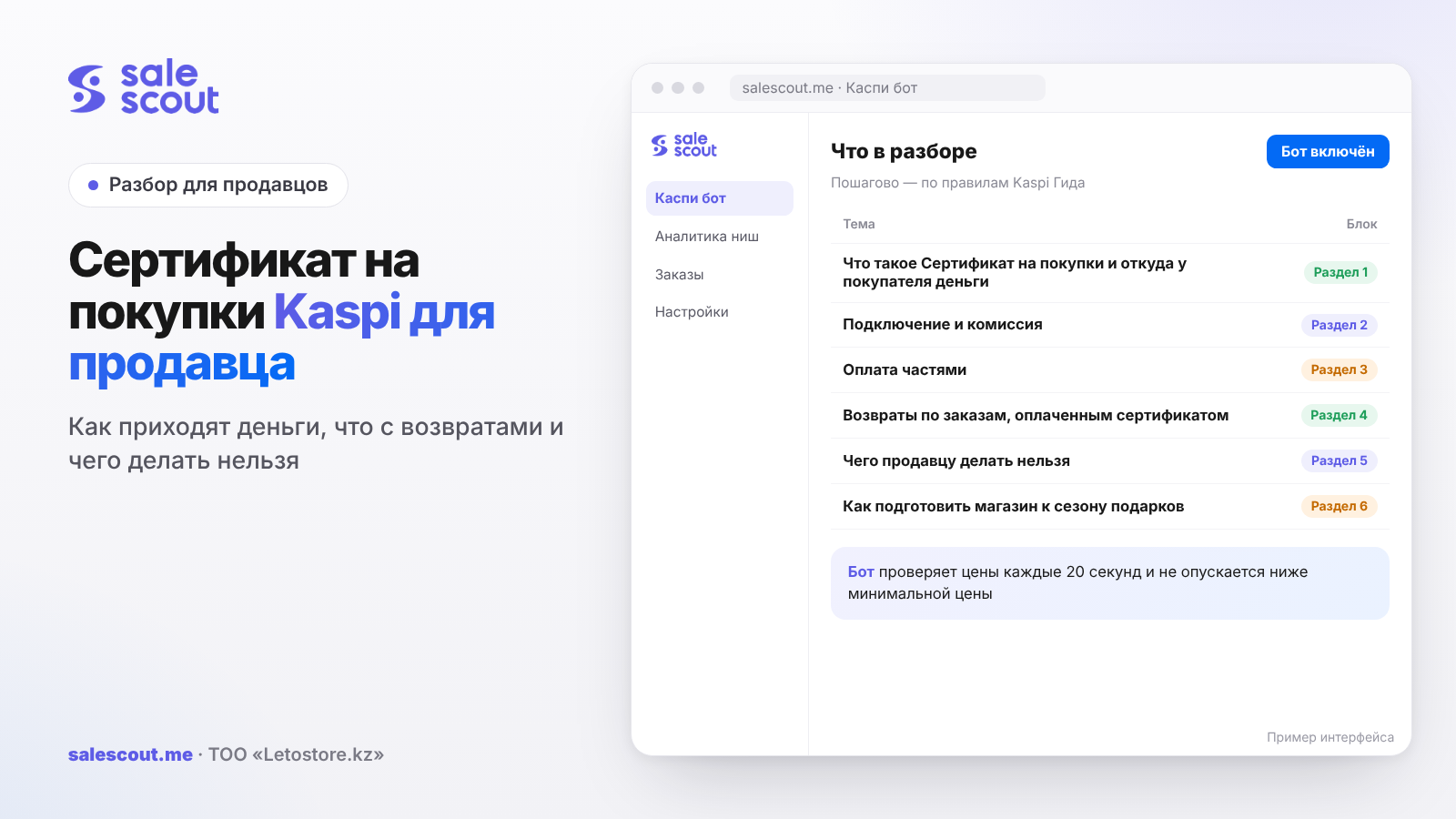
A Shopping Certificate is a gift one Kaspi customer gives another, and the recipient uses it to pay in the Kaspi.kz Store. For a seller, it's just another payment method: it's switched on automatically, and the commission is the same as for payment with Kaspi Gold, Kaspi Red+ or Kaspi Kredit. If an item is returned, the money goes back to the buyer's certificate. Kaspi's rules don't allow sellers to issue their own certificates or put them in orders.
In short
- The «Сертификат на покупки» (Shopping Certificate) payment method is enabled for your store automatically; you don't need to do anything.
- The commission on an order paid by certificate is the same as for Kaspi Gold: it depends on the product category, not the payment method.
- The buyer can top up the difference with Kaspi Gold, bonuses, Kaspi Red+, credit or installments. A certificate can't be combined with another bank's card.
- After a confirmed return, the money lands on the buyer's certificate within an hour. For you, the return goes through as usual.
What a Shopping Certificate is and where the buyer's money comes from
How it works for the buyer
A certificate is a universal gift used to pay for purchases in the Kaspi.kz Store (q16894, updated Mar 11, 2026). The giver picks a design and an amount, sends it right away or schedules a date, and a recipient over 16 gets an animated card in the Kaspi.kz app. The amount ranges from 3 to 500 thousand ₸ (q16905, updated May 5, 2025).
The certificate never expires and the balance doesn't burn, except for Magnum and Kaspi Travel certificates under individual promotions (q16898, updated Nov 18, 2025). It can't be cashed out (q16904) or re-gifted (q16912). Several certificates add up (q16911).
A small detail for the curious: one Guide page says a certificate can pay for "more than 20 million products", another says "more than 8 million" (q16901, updated Nov 18, 2025). The more recent page gives 20 million. What matters for sellers is something else: the description lists no category restrictions.
Why sellers should care
The money on a certificate is already in the buyer's hands and can only be spent in the Kaspi.kz Store. A person with a 30,000 ₸ certificate isn't deciding whether to buy. They're deciding what to buy. Kaspi doesn't publish figures on how many orders are paid with certificates, so there won't be any forecasts here. But the logic is clear: gifted money is easier to spend than your own.
Activation and commission
Nothing to switch on
The «Сертификаты на покупки в Магазине на Kaspi.kz» payment method is enabled automatically (q3657, updated Apr 21, 2026). There's no separate checkbox in the cabinet, and the Guide doesn't offer a way to turn it off separately either.
What it costs
It won't cost more. Kaspi says it plainly: for a certificate you pay the same as for Kaspi Gold, Kaspi Red+ or Kaspi Kredit (q3656, updated Jan 6, 2026). The rate is tied to the product category. During Kaspi.kz promotions it can be higher, but that's about the promotion, not the certificate. If the buyer cancels the order, your commission is refunded. For most categories the rate is 12.5% including VAT (q1344, updated Jan 6, 2026). Category details are in the article Kaspi commission for sellers.
Split payment: certificate plus top-up
What the buyer can top up with
If the certificate isn't enough, the buyer tops up with Kaspi Gold, Kaspi Bonuses, Kaspi Red+, credit or installments (q16907, updated Oct 10, 2024). A certificate can also cover delivery if the balance is enough (q16908, updated Oct 10, 2024).
A certificate doesn't work with another bank's card: it can only be used when paying with Kaspi Gold, Kaspi Red+, credit or installments (q17746, updated Aug 13, 2025). There's a separate article on paying with other banks' cards: paying with another bank's card on Kaspi.
The math: what the seller gets
Hypothetical example, not a client case. An item costs 42,000 ₸; the buyer pays with a 30,000 ₸ certificate and tops up 12,000 ₸ with Kaspi Gold. Purchase cost is 28,000 ₸; the seller is a sole proprietor (IE) on the simplified regime in Almaty at 3% (BES.media); in-city Kaspi Delivery up to 5 kg costs 1,275 ₸ including VAT (q2288, updated Jun 16, 2026).
| Item | Certificate + Gold | Gold only |
|---|---|---|
| Price | 42,000 ₸ | 42,000 ₸ |
| Commission 12.5% | 5,250 ₸ | 5,250 ₸ |
| Tax 3% | 1,260 ₸ | 1,260 ₸ |
| Delivery | 1,275 ₸ | 1,275 ₸ |
| Purchase cost | 28,000 ₸ | 28,000 ₸ |
| Profit | 6,215 ₸ | 6,215 ₸ |
Formula: profit = price − price × 0.125 − price × 0.03 − delivery − purchase cost. The columns are identical, and that's the main takeaway: for your economics, it doesn't matter which pocket the buyer paid from. What matters is the price that came into the order.
What this means for pricing
Since a certificate doesn't change the commission, there can't be a separate "certificate price". The rules explicitly ban selling an item at a higher price depending on the payment method, including discounts and promotions (the rules, clause 3.5, updated Sep 30, 2026). There's one price for everyone, and a certificate is simply the buyer's money.
Returns on orders paid by certificate
Where the money goes
Once the seller confirms the return, the money for the purchase lands on the buyer's certificate within an hour, and a notification about it arrives after 5 minutes (q16906, updated May 22, 2026). There's no limit on the number of returns per certificate (q18195, updated Jan 19, 2026).
For the seller, the procedure is the same as for any return: you confirm it, and the money is debited. The nuance is in communication. Buyers sometimes ask for the money back "to the card" instead of the certificate. You can't do that, and you shouldn't: the money goes back the same way the order was paid. Sending it personally by transfer is handing out money in place of an order, and the rules ban that (clause 1.3). More on returns in the article returns on Kaspi for sellers.
If the recipient returns the certificate
The recipient can decline the certificate within 30 days of receiving it (q16913, updated Jun 3, 2026). That has nothing to do with the seller: if nothing was bought with the certificate, you have no orders for it.
What sellers must not do
Your own coupons and certificates in the order
Clause 1.9 of the Store rules bans putting unrelated goods, items, money, coupons, certificates, marketing or any other materials not related to the order into the order, and mentioning such inserts in the product card (q1342). The exception is when a prize or gift is part of the product or an official manufacturer promotion stated on the product itself.
The idea of "I'll drop a card with 10% off your next purchase in my Instagram into the box" falls under this ban. If you want buyers to come back, there are tools for that inside Kaspi, such as seller bonuses.
A certificate "from the company"
You can't buy a Shopping Certificate from a company, only from an individual (q16919, updated Oct 9, 2024). If you want to give gifts to your staff, someone from management buys the certificates as a private person, and the «От кого» (From) field can say «От коллег» (From your colleagues) or the company name. Kaspi Bonuses aren't awarded for buying a certificate (q16910).
Going around the order
The rules require processing orders only in the seller cabinet (clause 1.1) and ban handing out money in place of an order (clause 1.3). A buyer with a certificate who suggests "pay for a different item with the certificate, but give me this one" is asking for exactly that. The answer is always the same: an order for the item they'll actually receive.
How to get your store ready for gift season
What you can do honestly
Certificates are given for holidays, so after New Year, March 8 and birthdays some buyers have gift money. The usual tools work here: stock on hand, current prices, good photos, fast delivery. There's nothing special "for certificates" in the cabinet.
If you want to check whether gift money affects your particular range, compare sales for a couple of weeks after major holidays with ordinary weeks. Kaspi doesn't publish those statistics, so your own orders are all you can rely on. See a spike? Then your fast sellers should be in stock ahead of the next holiday.
What not to do
Don't raise prices on holidays on the theory that "it's gifted money anyway". Buyers compare offers in the card just as they always do, and the card always shows the lowest price (q1059, updated Jun 15, 2026). How to prepare for demand peaks is covered in the article on seasonality of sales on Kaspi.
What to tell buyers: short answers for your manager
"How much is left on my certificate?"
The seller can't see this, but the buyer can at any time: on the main screen of the Kaspi.kz app, under Сервисы → Сертификаты. It shows the balance, the number of certificates and the purchase history (q16909, updated May 22, 2026). Just tell them that; it takes care of half the questions in chat.
"I'm a couple of thousand short, can I top up with my Halyk card?"
No, and it's better to say so before checkout. A certificate works together with Kaspi Gold, bonuses, Red+, credit or installments, but not with another bank's card. If the person has no Kaspi Gold, there's only one option: pick an item within the certificate amount.
"What if the item doesn't suit me?"
The return is standard, under the Store rules. Once you confirm it, the money goes back to the certificate, not the card, within about an hour. The certificate won't "burn" either: it has no expiry, and the returned money can be spent later.
"Can I pay with the certificate and pick up a different item?"
No. The buyer gets exactly what they ordered; anything else breaks the rules for you and, in effect, for them. Have them place a new order for the item they want; it takes a minute.
Why prepare this in advance
Certificate questions come in a wave after the holidays, mostly in chat. With answers at hand, your manager replies in a minute instead of digging through the Guide while the buyer leaves for the next seller in the card. How to handle buyer chats in general is in the article chatting with buyers on Kaspi.
Common mistakes sellers make with Kaspi certificates
- Refunding the buyer by transfer instead of through the order. That's handing out money in place of an order under clause 1.3, and the certificate money returns to the certificate within an hour of confirmation anyway.
- A coupon card in the box. A breach of clause 1.9. A 10% discount on the next purchase isn't worth the risk of sanctions against your store.
- Promising a "special certificate price". The price can't depend on the payment method (clause 3.5), and the commission on a certificate is the same as on Kaspi Gold.
- Buying certificates for staff "from the LLP". You can't buy from a company, only from an individual. Time spent hunting for the button in Kaspi Pay is wasted.
- Telling a buyer to "top up with another bank's card". A certificate can't be combined with another bank's card, the order won't go through, and the buyer leaves for the next seller in the card.
- "Take the other model, don't worry about the difference". Swapping an item without a new order means the buyer receives something other than what's in the order, which is directly banned by clause 3.1 of the rules. Plus confusion on returns: money goes back to the certificate for one item while the buyer is holding another.
- Answering "we don't know" about the balance. The seller can't see the balance but can tell the buyer where to check it. A buyer who gets help in a minute is more likely to complete the order.
- Raising prices for the holidays. The lowest price wins in the card; gift money doesn't change that.
Checklist: sellers and the Kaspi Shopping Certificate
- Nothing needs setting up: certificate payment is on for everyone.
- Managers know the commission on these orders is standard, the same as Kaspi Gold.
- Returns go only through the cabinet; the money goes back to the certificate on its own.
- There are no coupons, flyers or "our own" certificates in the box.
- One price, whatever the payment method.
- When asked "what can I top up with", the manager answers right away: Gold, bonuses, Red+, credit or installments.
- Stock and prices of fast sellers are checked before the holidays.
- Gifts for colleagues are bought by an individual, signed «От коллег».
How to automate prices in gift season
A buyer with a certificate chooses like everyone else: by price, rating and delivery time, and the lowest price is always in view. The SaleScout Kaspi bot checks prices every 20 seconds, keeps you at the top of the card and never goes below the minimum price you set. When a competitor raises their price or leaves the card, the bot raises your price to just below the next seller. You can try the bot free for 7 days, no card required.
Frequently asked questions about the Kaspi Shopping Certificate for sellers
How do I enable certificate payment in the Kaspi.kz Store?
You don't; it's enabled automatically. There are no separate settings for it in the seller cabinet.
What's the commission if the buyer paid with a certificate?
The same as for payment with Kaspi Gold, Kaspi Red+ or Kaspi Kredit. It depends on the product category: for most categories it's 12.5% including VAT.
Where does the money go if an item paid by certificate is returned?
To the buyer's certificate, within an hour of you confirming the return. You don't need to, and must not, transfer money personally.
Can part of an order be paid with a certificate?
Yes. The buyer tops up the rest with Kaspi Gold, Kaspi Bonuses, Kaspi Red+, credit or installments. Topping up with another bank's card isn't possible.
Can a seller issue their own certificates on Kaspi?
No. The rules ban putting coupons and certificates in orders, and Kaspi Shopping Certificates are bought and given only by individuals.
Can I buy certificates for staff on behalf of an LLP?
You can't buy from a company. An individual buys them, and the «От кого» field can say «От коллег» or the company name.
Where does the buyer see the certificate balance?
In the Kaspi.kz app: Сервисы → Сертификаты. Sellers aren't shown this data, so it's easiest to point the buyer there straight away.
Can a certificate pay for delivery?
Yes, if the certificate balance is enough. For the seller nothing changes: delivery is paid as part of a normal order.
Sources
All links checked Oct 23, 2026. The sources are in Russian; original titles are given with English translations.
- Kaspi Guide for customers. «Что такое Сертификат на покупки в Магазине на Kaspi.kz?» (What is a Shopping Certificate in the Kaspi.kz Store?) — https://guide.kaspi.kz/client/ru/certificate/general/shop/q16894 (updated Mar 11, 2026); validity — https://guide.kaspi.kz/client/ru/certificate/general/shop/q16898 (updated Nov 18, 2025)
- Kaspi Guide for customers. Giver: amount — https://guide.kaspi.kz/client/ru/certificate/giver/shop/q16905 (updated May 5, 2025); from a company — https://guide.kaspi.kz/client/ru/certificate/giver/shop/q16919 (updated Oct 9, 2024); bonuses — https://guide.kaspi.kz/client/ru/certificate/giver/shop/q16910 (updated Oct 9, 2024)
- Kaspi Guide for customers. Recipient: use — https://guide.kaspi.kz/client/ru/certificate/recipient/shop/q16901 (updated Nov 18, 2025); partial payment — https://guide.kaspi.kz/client/ru/certificate/recipient/shop/q16907 (updated Oct 10, 2024); delivery — https://guide.kaspi.kz/client/ru/certificate/recipient/shop/q16908 (updated Oct 10, 2024); balance — https://guide.kaspi.kz/client/ru/certificate/recipient/shop/q16909 (updated May 22, 2026); cash, re-gifting, combining — https://guide.kaspi.kz/client/ru/certificate/recipient/shop/q16904, https://guide.kaspi.kz/client/ru/certificate/recipient/shop/q16912, https://guide.kaspi.kz/client/ru/certificate/recipient/shop/q16911
- Kaspi Guide for customers. Returns — https://guide.kaspi.kz/client/ru/certificate/recipient/shop/q16906 (updated May 22, 2026), https://guide.kaspi.kz/client/ru/certificate/recipient/shop/q18195 (updated Jan 19, 2026); certificate returned by the recipient — https://guide.kaspi.kz/client/ru/certificate/recipient/shop/q16913 (updated Jun 3, 2026)
- Kaspi Guide for customers. Certificate and another bank's card — https://guide.kaspi.kz/client/ru/shop/receive/card/q17746 (updated Aug 13, 2025); choosing a seller — https://guide.kaspi.kz/client/ru/shop/choice/q1059 (updated Jun 15, 2026)
- Kaspi Guide for partners. Enabling certificate payment — https://guide.kaspi.kz/partner/ru/shop/conditions/q3657 (updated Apr 21, 2026); cost of accepting it — https://guide.kaspi.kz/partner/ru/shop/conditions/q3656 (updated Jan 6, 2026); commission — https://guide.kaspi.kz/partner/ru/shop/conditions/q1344 (updated Jan 6, 2026)
- Kaspi Guide. Kaspi.kz Store rules — https://guide.kaspi.kz/partner/ru/shop/conditions/q1342 (updated Sep 30, 2026); Kaspi Delivery — https://guide.kaspi.kz/partner/ru/shop/delivery/shipping/q2288 (updated Jun 16, 2026)
- BES.media. «В регионах Казахстана снизили налог по упрощёнке на 2026 год» (Simplified-regime tax cut in Kazakhstan's regions for 2026) — https://bes.media/news/v-regionah-kazahstana-snizili-nalog-po-uproshyonke-na-2026-god/
Bota, analyst
SaleScout is our company's product. Kaspi and Kaspi.kz are trademarks of Kaspi.kz JSC; SaleScout is not affiliated with Kaspi.