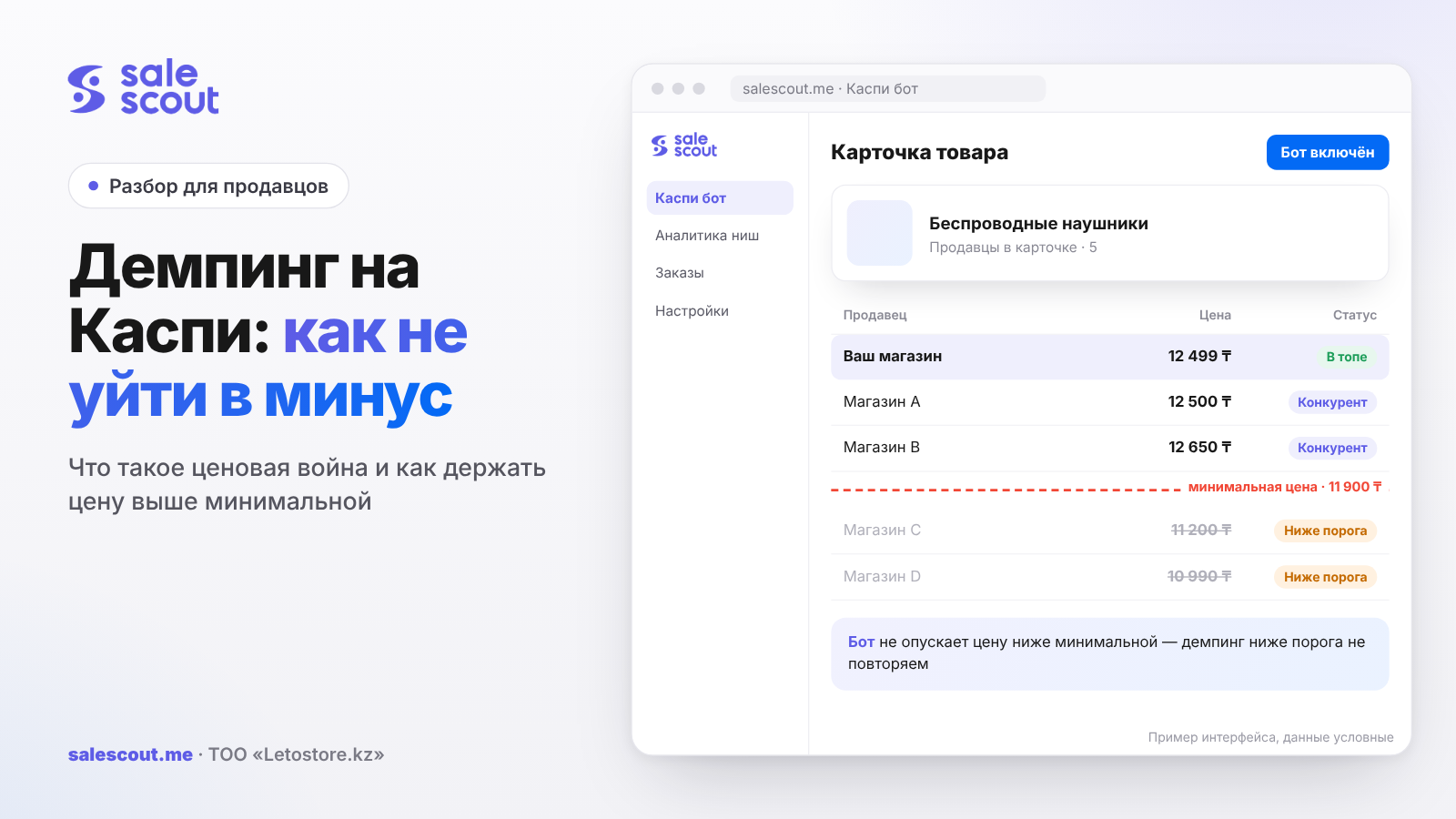
Price dumping on Kaspi is competing for the top spot in a product card on price: you set your price slightly below a competitor's, move up the list of sellers and win the order. On fast-moving items almost everyone does it, so the question isn't whether to dump. The question is where your floor is and whether you know it down to the tenge.
In short
- Kaspi Guide names five things that determine the order of sellers: bonuses, price, rating, number of reviews and delivery speed. Of these, price is the only one you can change today.
- The minimum price isn't calculated from the purchase cost. It includes the whole chain: Kaspi's fee including VAT, Kaspi Delivery, tax, advertising, packaging, a returns reserve, and the profit that made it all worthwhile.
- Some costs are percentages of the price, and they grow with it. That's why the formula divides instead of adding, and mixing this up costs hundreds of tenge per order.
- A 1 ₸ step, raising your price after a competitor leaves, and walking away from hopeless cards earn more than holding first place at any cost.
How Kaspi ranks sellers in a product card
Every product on Kaspi has one product card, and all the stores selling it sit inside it as a list. At the top the customer sees the lowest price; below it, the sellers in order. That order isn't random.
What Kaspi says officially
The Kaspi Guide for partners (Kaspi's official help center for sellers) lists five factors that affect seller placement (Kaspi Guide, "How sellers are ranked in a product card", updated Jun 15, 2026):
- Seller bonuses. Partners who give bonuses (Kaspi's cashback points) for a purchase appear at the top of the list.
- Price. If there are no bonuses, or they are equal, the seller with the lower price ranks higher.
- Rating. At equal prices, the seller with the better rating comes first.
- Reviews. With equal price, bonuses and rating, the seller with more reviews ranks higher.
- Delivery speed. The seller with the fastest delivery always makes the top 3. If they lose on price and bonuses, they take third place.
The same page also says that a seller with a lower price will be first even if others have a higher rating and bigger bonuses. That doesn't sit well with the first point. Kaspi notes that the app is updated gradually, so the order may differ between app versions. The practical takeaway is simple: look at your card the way a shopper does, on a phone, not through what people retell in seller chats.
The guide for shoppers has another important detail (Kaspi Guide for customers, updated Feb 23, 2026). If the lowest price is set by a seller rated 3 stars or lower, their offer goes into the general list under the «Ещё предложения» ("More offers") button. The top of the card shows sellers rated above 4 stars with a good, though not necessarily the lowest, price.
What this means for sellers
- Dumping with a poor rating is almost pointless. You can be the cheapest and still not reach the top of the list. Rating first, price second.
- Fast delivery is a separate way into the top 3. If you ship faster than competitors, third place can be yours without the lowest price. That's a reason not to go down to the last tenge where you're already visible.
- Ties on price are settled by rating and reviews. If two shops sit at the same price, the one with the better reputation wins. That's also the logic behind the 1 ₸ step: formally, it's enough to rank higher.
What Kaspi doesn't disclose
What Kaspi doesn't tell you: how much each factor weighs, how often the order is recalculated, and how stock and the customer's city play into it. So if someone confidently writes "Kaspi updates the top every N minutes" without a link to Kaspi, that's a guess. You can build your own picture: change the price, note the time, watch when your position moves.
Unit economics: what goes into the price of one order
Before you cut your price, you need to know how much you net on one order. Below are the main cost items for a Kaspi seller, with current rates.
Kaspi fee
The sales fee depends on the category and is fixed (Kaspi Guide, "What is the sales fee"; Kaspi 2026 fee schedule, PDF). Since January 5, 2026, Kaspi shows the fee excluding VAT and charges the tax on top (Kaspi Guide). According to the official schedule, the range is:
| Category (examples) | Excl. VAT | Incl. VAT (per Kaspi schedule) |
|---|---|---|
| Groceries | 6.4% | 7.3% |
| Pharmacy, pet supplies | 6.4–10.9% | 7.3–12.5% |
| Most categories: clothing, footwear, home, appliances, computers, beauty | 10.9% | 12.5% |
| Phones and gadgets, TV/audio/video, accessories | 10.9–13.5% | 12.5–15.5% |
| Jewelry | 13.5% | 15.5% |
Two caveats. During 0-0-24 installment promotions (0% interest, no down payment, 24 months), the fee may differ: check the terms in the seller cabinet under «Маркетинг → Акции» (Marketing → Promotions). And if you're an individual entrepreneur (IP) on the simplified regime and not registered for VAT, you can't offset the VAT on the fee, so use the VAT-inclusive rate in your calculations.
Kaspi Delivery
What you're charged for delivery depends on order value, weight and destination (Kaspi Guide, "How much does Kaspi Delivery cost"; rates effective from January 1, 2026). An order from 10,000 ₸ and up to 5 kg costs 1,099 ₸ within the city, 1,299 ₸ across Kazakhstan, 1,699 ₸ by express, all excluding VAT. The money is charged including VAT, and only once the order is «Выдан» ("Delivered"). From 2026, VAT is 16% (Article 503 of the Tax Code of Kazakhstan), so 1,099 ₸ becomes about 1,275 ₸.
A separate note on 10,000 ₸. Below that amount, from 5,000 ₸, delivery costs 699–799 ₸ excluding VAT, and above it, more than a thousand. If you're dumping somewhere around ten thousand, recalculate your minimum price for both sides of the threshold, or a single 1 ₸ step can cost you four hundred.
Tax under the simplified regime
From 2026, the base rate under the simplified declaration (a turnover-based tax regime popular with individual entrepreneurs) is 4% of income, and maslikhats (local representative councils) can change it by up to 50%, i.e. to anywhere from 2% to 6% (MCFR Glavbukh). Many regions lowered the rate for 2026: 3% in Astana and Almaty, 2% in Shymkent (BES.media, Dec 1, 2025). Check the rate for your district in the maslikhat's decision. The tax is levied on income, not profit, so when you dump it eats into your margin just like the fee.
Advertising, packaging, returns
These three lines are the easiest to skip. Advertising per order is simple to get: divide your monthly Kaspi Marketing budget by the number of orders that came from ads. Packaging also means seals, courier bags and paper for delivery notes. And put returns with defects in as a percentage of the price, based on your own history; if you don't have any history yet, take a generous figure and come back to it in a month.
Worked example: how much is left from an order
As an example, take wireless earbuds (a hypothetical example, not a client case). The category is "Phones and gadgets", which Kaspi's table puts at 10.9% excluding VAT or 12.5% including VAT. They're sold by an individual entrepreneur on the simplified regime in Almaty, at a 3% rate, with in-city delivery and a weight under 5 kg. We estimated the purchase cost, packaging, advertising and returns roughly.
| Item | How it's calculated | At a price of 15,000 ₸ |
|---|---|---|
| Purchase cost incl. delivery to warehouse | example | 8,500 ₸ |
| Kaspi fee | 12.5% of price | 1,875 ₸ |
| Kaspi Delivery | 1,099 ₸ + 16% VAT | 1,275 ₸ |
| Tax, simplified regime | 3% of price | 450 ₸ |
| Advertising per order | example | 600 ₸ |
| Packaging | example | 150 ₸ |
| Returns reserve | example, 1% of price | 150 ₸ |
| Total costs | 13,000 ₸ | |
| Net per order | 2,000 ₸ |
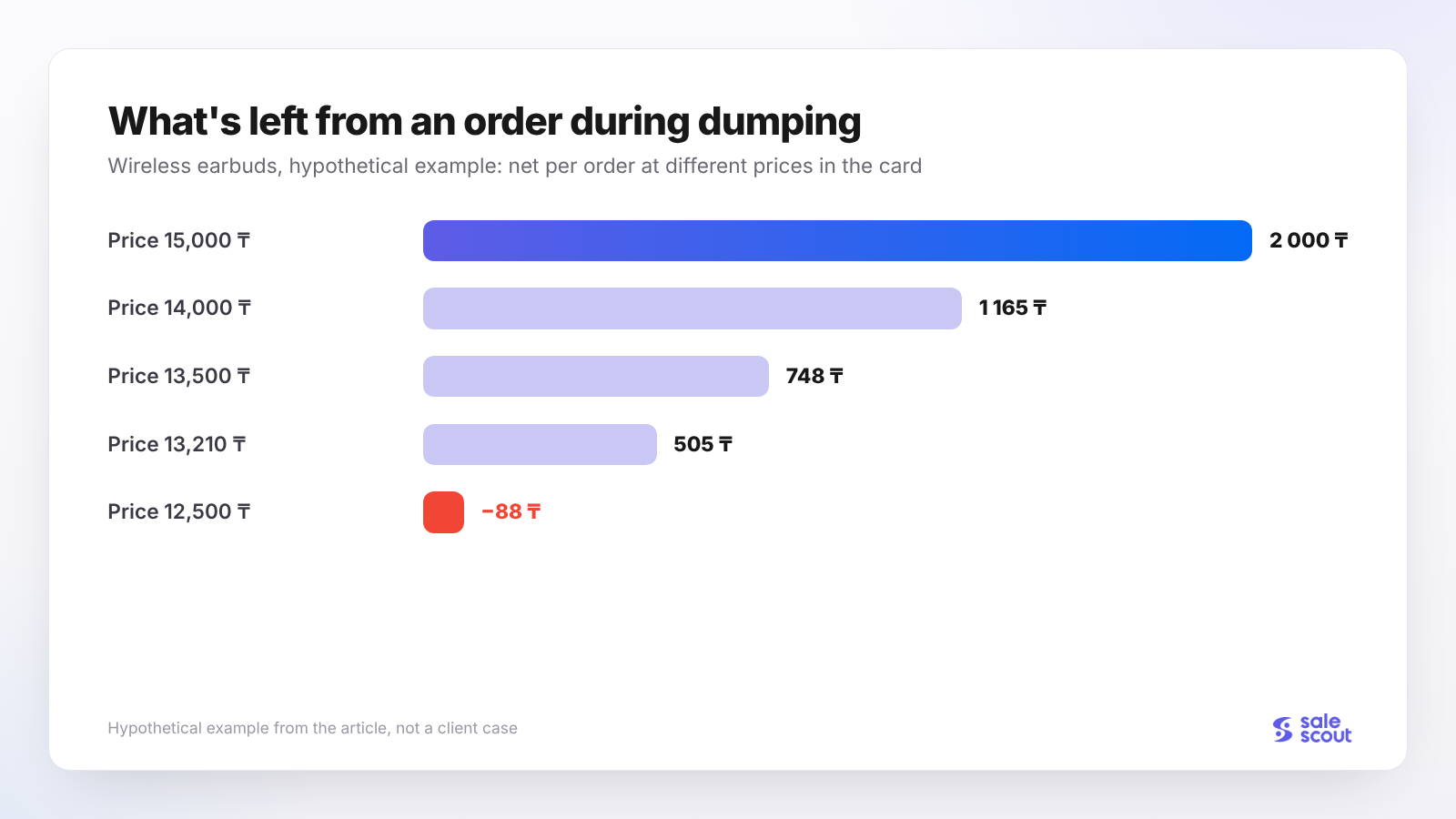
At 15,000 ₸ the cushion looks big. Now see what happens when dumping starts in the card:
| Price in card | Percentage costs (16.5%) | Fixed costs | Net |
|---|---|---|---|
| 15,000 ₸ | 2,475 ₸ | 10,525 ₸ | 2,000 ₸ |
| 14,000 ₸ | 2,310 ₸ | 10,525 ₸ | 1,165 ₸ |
| 13,500 ₸ | 2,228 ₸ | 10,525 ₸ | 748 ₸ |
| 13,210 ₸ | 2,180 ₸ | 10,525 ₸ | 505 ₸ |
| 12,500 ₸ | 2,063 ₸ | 10,525 ₸ | −88 ₸ |
The price fell by 2,500 ₸, but profit fell by 2,088 ₸: the fee and tax absorbed the rest of the blow, since they went down too. But the cushion runs out fast, and at 12,500 ₸ every order is already loss-making. Break-even for these earbuds is about 12,605 ₸. Adding up only the "fixed" costs would give 10,525 ₸, and there it is: the two-thousand gap where people sell at a loss.
The minimum price formula
Your minimum price is the price you never go below, whether by hand or with a bot. You can't get it by addition, because the fee, tax and returns reserve are calculated from the price itself. The formula:
Minimum price = (Purchase cost + Delivery + Advertising per order + Packaging + Target profit) ÷ (1 − Fee − Tax − Returns reserve)
Enter all percentages as decimals: 12.5% = 0.125.
For our example with a target net profit of 500 ₸:
- numerator: 8,500 + 1,275 + 600 + 150 + 500 = 11,025 ₸;
- denominator: 1 − 0.125 − 0.03 − 0.01 = 0.835;
- minimum price: 11,025 ÷ 0.835 ≈ 13,204 ₸, rounded up to 13,210 ₸.
Check against the table above: at 13,210 ₸ you're left with exactly the planned 505 ₸, so the formula got it right.
How to choose your target profit
Target profit isn't "what I'd like to make" but what it takes for the product to pay back the working capital and your time. Points to guide the decision:
The first is how fast the product sells. If a batch sells in a week, a thin margin is fine: the money comes back quickly and goes back to work. If it sits for two months, profit per unit should be noticeably higher, or you're just storing money on a shelf.
The second is defects and returns. Earbuds and dresses with a size chart need a bigger cushion than paper towels.
And the third is why the item is in your assortment at all. Sometimes a product is kept at almost no margin for the sake of reviews and the store's rating. That's fine if the decision was made deliberately and there's a date in your calendar to revisit it.
When to recalculate
Your minimum price goes stale. Recalculate it when a new batch arrives at a different purchase cost, when Kaspi changes its rates (both the fee and delivery changed in 2026), when you cross the 10,000 ₸ threshold, when your ad budget changes, and at the start of the tax year, when maslikhats may change the rate.
Dumping strategies
Manual pricing
This works if you have few products and your cards have one or two competitors who barely touch their prices. You make every decision yourself, which is a plus. The minus is speed. A competitor cut their price at ten in the morning, you noticed at four, and for half a day the orders went to them. And once you have a few dozen SKUs, manual tracking eats the whole working day, and sooner or later 1,299 ₸ goes into the card instead of 12,990 ₸.
Automated repricing
A dumping bot, or Kaspi bot, as sellers call it, watches prices in the card and changes your price according to rules you set. A good bot does three things: reacts fast, never goes below your minimum price, and can raise the price, not just lower it. A bot that can only lower prices automates a price war, not sales.
Before connecting any bot, check:
- whether you can set a minimum price for each product separately;
- what the bot does when a competitor is below your minimum price (the right answer: it holds at the floor);
- whether the bot raises the price when a competitor goes up or leaves the card;
- whether you can exclude specific products and competitor shops.
The 1 ₸ step
According to Kaspi's official description, with equal bonuses the seller with the lower price ranks higher. So 1 ₸ is enough to overtake. A 100 or 500 ₸ step "to be safe" adds nothing to your position but comes straight out of your margin and invites the competitor to respond with an equally large step. On a fast-moving item, the difference between a 1 ₸ and a 200 ₸ step adds up to noticeable money over a month. Run it on your own volume: step × number of orders.
Raising your price after a competitor
This strategy is easy to underestimate. On a Friday evening a competitor sells out and disappears from the card, or simply raises their price, and you're still sitting down below, even though the next seller is 800 ₸ more expensive. Rise to 1 ₸ below them. Same place in the card, and those 800 ₸ minus one tenge stay with you on every order. Lowering protects your share, raising wins back margin, and without the second, the first works at half strength.
Nights and weekends
If the competitors in your card change prices manually, the logic is simple: if they don't watch the card at night and on weekends, you can sit higher during those hours without losing your position, or, the other way round, take the top while nobody is reacting. We found no public data on how demand and seller activity on Kaspi change by hour, so test it on your own cards. Start with two weeks of observation on your fastest-moving SKUs and see whether your niche has a night window.
Price wars: when to leave a card
A price war starts when two or more sellers with automated repricing run into each other. The price creeps down in 1 ₸ steps until someone hits their minimum price. From there, purchase cost decides everything: whoever buys cheaper stays on top.
Signs it's time to let a card go
- A competitor has consistently stayed below your break-even point for more than a week. Either their purchase cost is different or they're selling at a loss, but either way you don't need to chase them.
- Your floor is calculated correctly, yet you hold the top of the card for only a few hours a day.
- An official seller or distributor has appeared in the card with a purchase cost you can't match.
- The money tied up in stock is needed more for a product where you're consistently on top.
What to do instead of racing
There are several options, and none of them requires going below your minimum price. You can sit at it and wait: whoever is dumping at a loss eventually runs out of stock or patience. You can work on the things Kaspi also counts: rating, reviews, delivery speed. You can move your working capital into quieter cards. And if the item matters to you, revisit your purchase cost: a price war isn't won by the fastest seller but by the one with the lowest cost.
Common mistakes
- "Purchase cost plus twenty percent or so." It sounds like a calculation, but it isn't one: a 12.5% fee, 3% tax, delivery and advertising easily eat up those twenty percent entirely.
- Adding instead of dividing. You added 16.5% of the purchase cost to your costs instead of dividing by 0.835: the minimum price is too low, and the bot will faithfully sell at a loss.
- The fee excluding VAT. Since 2026 Kaspi shows it excluding VAT. If you don't pay VAT, use the "incl. VAT" column.
- The 10,000 ₸ threshold. A minimum price near it that wasn't recalculated for the new delivery rate is exactly that "inexplicable" loss.
- A bot that can only lower prices. The competitor left, and you're still down below. Money is left on the table every day.
- Dumping with a low rating. At 3 stars or lower you can end up under «Ещё предложения» ("More offers") even as the cheapest seller.
- A minimum price calculated in January. By summer the purchase cost, rates and tax rates have changed, but the floor is the same.
Checklist before you start dumping
- A minimum price is calculated for each SKU using the division formula.
- The calculation uses your category's VAT-inclusive fee from Kaspi's schedule.
- The Kaspi Delivery rate is taken by weight, route and order value, including VAT.
- The tax rate follows your district maslikhat's decision for the current year.
- Advertising per order is calculated from your actual Kaspi Marketing budget.
- Prices on both sides of the 10,000 ₸ threshold are checked if the product is close to it.
- Your shop's rating is above 4 stars; otherwise, work on the rating first.
- The price-cut step is 1 ₸ unless you have a reason to go bigger.
- The rule to raise your price after a competitor leaves or goes up is switched on.
- Once a week you check how much you netted, not how long you spent at the top.
How to automate it
When you have dozens or hundreds of products, watching every card by hand isn't realistic. That's what dumping bots are for. The SaleScout Kaspi bot checks prices every 20 seconds, puts you at the top of the card, never goes below the minimum price you set, and raises the price when a competitor goes up or leaves. Halyk Market is supported too. You can try the bot free for 7 days, no card required. You still calculate the minimum price yourself: the bot executes your rules, and you need the formula above either way.
FAQ
What is price dumping on Kaspi in simple terms?
It's setting your price slightly below a competitor's in the same product card to move up the list of sellers and get the order. Sellers do this constantly on fast-moving products, so the price in popular cards can change many times a day.
How does Kaspi decide who is first in a product card?
According to the Kaspi Guide, the order is affected by seller bonuses, price, rating, number of reviews and delivery speed. The seller with the fastest delivery always makes the top 3. Sellers rated 3 stars or lower can end up in the «Ещё предложения» ("More offers") section even if their price is the lowest.
How do I calculate my minimum price on Kaspi?
First add up everything that doesn't depend on price: purchase cost, delivery, advertising per order, packaging and the profit you want to make. Then divide by one minus the percentages: the fee, tax and returns reserve. In our hypothetical example, 11,025 ₸ ÷ 0.835 ≈ 13,210 ₸; your numbers will be your own.
What is Kaspi's sales fee in 2026?
It depends on the category. In Kaspi's official table the range is 6.4–13.5% excluding VAT, or 7.3–15.5% including VAT. Most categories are at 10.9% excluding VAT, which is 12.5% including VAT. In 0-0-24 installment promotions the terms can be different, so check before joining a promotion.
What price-cut step should I use when dumping?
1 ₸ is enough. When bonuses are equal, the lower price ranks higher, no matter by how much. A 100 ₸ step won't gain you a place but will cut your profit, and it also teaches competitors to respond with jumps of the same size.
What should I do if a competitor drops below my minimum price?
Stop at your minimum price and don't follow them. If they stay below your break-even point for more than a week, move your money into other cards and work on rating, reviews and delivery speed. When the competitor goes up or leaves, raise your price to 1 ₸ below the next seller.
Sources
All links checked Oct 15, 2026. The sources are in Russian; original titles are given with English translations.
- Kaspi Guide for partners. «Как располагаются продавцы в карточке товара в Магазине на Kaspi.kz?» ("How are sellers ranked in a product card in the Kaspi.kz Store?") — https://guide.kaspi.kz/partner/ru/shop/goods/general/q3190 (updated Jun 15, 2026)
- Kaspi Guide for customers. «Почему в карточке товара самая низкая цена, но я не могу найти её у продавцов?» ("Why does a product card show the lowest price, but I can't find it among the sellers?") — https://guide.kaspi.kz/client/ru/shop/choice/q18442 (updated Feb 23, 2026)
- Kaspi Guide for partners. «Какая комиссия за продажи в Магазине на Kaspi.kz?» ("What is the sales fee in the Kaspi.kz Store?") — https://guide.kaspi.kz/partner/ru/shop/conditions/q1344 (updated Jan 6, 2026)
- Kaspi. Тарифы Магазина на Kaspi.kz 2026 ("Kaspi.kz Store fees 2026", PDF) — https://guide.kaspi.kz/cdn/content/pay/product/documents/Magazin/Tarify_Magazina_na_Kaspi_kz_2026.pdf
- Kaspi Guide for partners. «Что поменялось в расчёте комиссии с 5 января 2026 года?» ("What changed in fee calculation from January 5, 2026?") — https://guide.kaspi.kz/partner/ru/shop/conditions/q4467 (updated Feb 2, 2026)
- Kaspi Guide for partners. «Сколько стоит Kaspi Доставка?» ("How much does Kaspi Delivery cost?") — https://guide.kaspi.kz/partner/ru/shop/delivery/shipping/q2288 (updated Jun 16, 2026)
- Tax Code of the Republic of Kazakhstan, Article 503 «Ставки НДС» ("VAT rates") — https://www.zakonpravo.kz/ru/statya-503-stavki-naloga-na-dobavlennuyu-stoimost-nalogovogo-kodeksa-respubliki-kazahstan
- MCFR Glavbukh. «Налоги ИП в Казахстане 2026» ("Taxes for individual entrepreneurs in Kazakhstan, 2026") — https://buh.mcfr.kz/article/507-kakie-nalogi-platit-ip
- BES.media. «В регионах Казахстана снизили налог по „упрощёнке“ на 2026 год» ("Kazakhstan's regions cut the simplified-regime tax for 2026"), Dec 1, 2025 — https://bes.media/news/v-regionah-kazahstana-snizili-nalog-po-uproshyonke-na-2026-god/
Bota, SaleScout analyst
This article is for information only and does not replace calculations by your accountant. SaleScout is our company's product. Kaspi and Kaspi.kz are trademarks of Kaspi.kz JSC; SaleScout is not affiliated with Kaspi.